Discover the best mahi-mahi fishing destinations, guided trips, and lodge-based experiences worldwide. Explore remote waters and world-class angling with expert local hosts.
Abaco, The Bahamas
Barracuda, Bonefish, Grouper
Pacific Region, Colombia
Amberjack, Bigeye Tuna, Cubera Snapper
No results available
Mahi-mahi are fast, colorful, and aggressive predators found in warm offshore waters worldwide. Known for their acrobatic fights and vivid coloring, they’re often caught near weed lines, floating debris, and current edges.
Also known as dorado or dolphinfish, mahi-mahi (Coryphaena hippurus) are a favorite among offshore anglers for both their beauty and performance. These pelagic fish strike with speed and power, often in visual surface attacks. Note that dorado is also used in parts of Central and South America to refer to the golden dorado (Salminus brasiliensis), an entirely different freshwater species — the two are unrelated.
Anglers typically target mahi-mahi by trolling along current lines, casting to floating debris, or working around fish aggregating devices (FADs). They often travel in pairs or loose schools, and their tendency to stay near surface structure makes them accessible to well-positioned offshore trips.
Mahi-mahi are common off both coasts of Mexico, especially around Baja California and the Yucatán Peninsula near offshore drop-offs. Both coasts offer boat-based access to deepwater currents and floating debris where mahi-mahi congregate.
The Bahamas offers consistent offshore fishing for mahi-mahi, particularly along the deep channels between islands. Peak season typically runs from April through July when floating debris and weed lines concentrate fish.
From Key West to Texas, mahi-mahi appear in strong numbers along sargassum lines and drop-offs during warm months. The action can be strong during spring bait migrations.
Destinations like Colombia, Costa Rica, Puerto Rico, and the Dominican Republic offer good access to mahi-mahi, especially during spring bait migrations. Fish are often caught while trolling for billfish or tuna along current lines and offshore drop-offs.
Hawaiian waters hold some of the world’s largest mahi-mahi, often found near anchored or drifting FADs. Fish over 50 lbs are not uncommon, especially in spring and early summer.
Countries like Panama, Ecuador, and Peru provide offshore access to mahi-mahi along current edges and around floating debris — especially during warm oceanic phases.
From Kenya to the Seychelles and Mauritius, mahi-mahi are commonly found near drop-offs, FADs, and seasonal bait lines — a reliable offshore target in mixed-species programs.
New Zealand, Fiji, and Tahiti all offer mahi-mahi opportunities near reef systems and current-rich offshore zones, adding variety to multi-day pelagic trips.
Mahi-mahi are among the most visually striking fish in the ocean, flashing neon greens, blues, and golds the moment they strike. Their speed and aerial fights are thrilling, and their behavior around floating structure or weed lines makes for interactive, visual fishing. As fast growers and abundant migrants, they’re a consistent high-action offshore species.
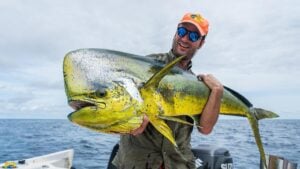
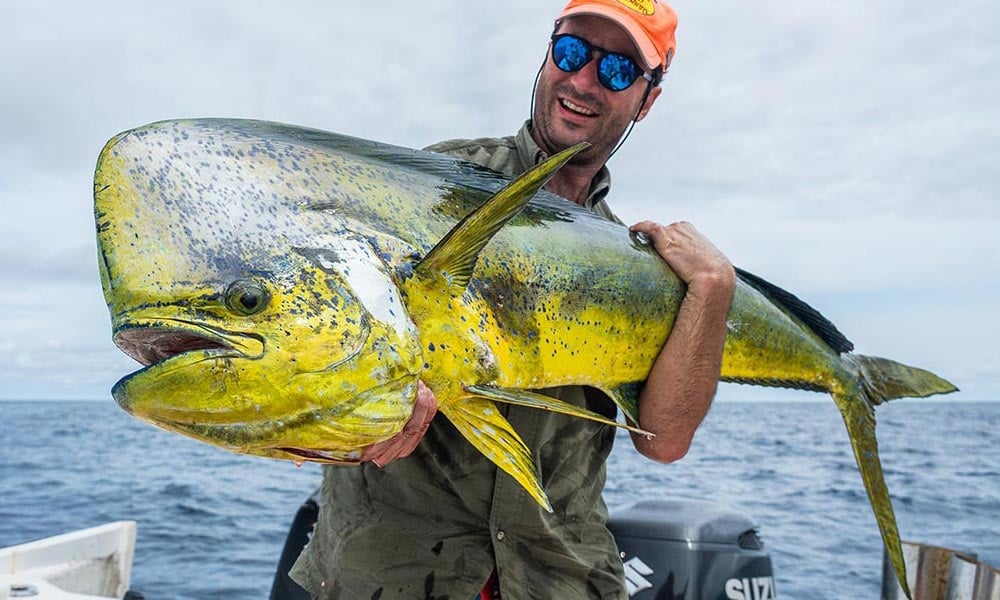
Mahi-mahi have a long, compressed body with a blunt head and a single dorsal fin running from the head almost to the tail. Adult males develop a distinctive steep, squared-off bony ridge on the forehead that protrudes well above the body profile — the most reliable field mark for distinguishing bulls from females, which have a rounded head. The back is metallic blue-green; the sides are golden-yellow to silvery-gold with irregular dark spots and iridescent blue-green patches; the belly is silvery-white to yellow-white. The dorsal fin is dark green to deep blue; other fins are typically yellow to orange; pectoral fins are iridescent blue. These colors fade rapidly after death.
Their presence is closely tied to temperature, currents, and bait movement. Look for concentrated sargassum, floating debris, or current edges to improve chances.
FishingExplora connects you with lodge-based offshore fishing experiences in Colombia, where mahi-mahi are regularly encountered in-season alongside tuna, wahoo, and billfish. Contact lodges directly to discuss offshore program availability and seasonal timing.
FishingExplora’s editorial content draws on lodge input, guide experience, published field reports, and independent research to help anglers make informed decisions about premium fishing destinations.
Mahi-mahi live in warm offshore waters around the globe, typically within the top 85 metres of the water column near floating debris, sargassum lines, or current breaks. They are found in tropical and subtropical oceans worldwide, from the Atlantic and Pacific to the Indian Ocean.
Most mahi-mahi caught by anglers run 10–30 lbs, with large bulls exceeding 50 lbs in productive fisheries like Hawaii and the Eastern Pacific. The IGFA all-tackle world record is 87 lbs, caught off Costa Rica in 1976. They are fast growers, reaching maturity within the first year of life.
Yes — mahi-mahi are considered excellent table fare. Their firm, white flesh is mild and holds up well grilled, seared, or in ceviche. Their short life cycle also makes them a relatively sustainable offshore species compared to long-lived pelagics.
Yes. When mahi-mahi are near floating debris or feeding near the surface, they will take streamer flies stripped quickly. A 10-weight rod with a baitfish pattern is standard. The bait-and-switch technique — using hookless teasers to excite fish before presenting the fly — is particularly effective.
We use cookies to improve your experience and enable key features on the platform. You can choose which cookies to allow. Some features may not work fully without consent.