Discover the best tarpon fishing destinations, guided trips, and lodge-based experiences worldwide. Explore remote waters and world-class angling with expert local hosts.
Pacific Region, Colombia
Amberjack, Bigeye Tuna, Cubera Snapper
South Andros, The Bahamas
Bonefish, Permit, Tarpon
Abaco, The Bahamas
Barracuda, Bonefish, Grouper
Abaco, The Bahamas
Amberjack, Barracuda, Bonefish
Yucatan Peninsula, Mexico
Barracuda, Bonefish, Grouper
Gabon, Central Africa
Cubera Snapper, Giant African Threadfin, Jack Crevalle
Mangrove Cay, The Bahamas
Barracuda, Bonefish, Snapper
No results available
Tarpon — often called the Silver King — are among the most iconic and powerful gamefish in the world. Whether sight-casting on shallow flats or battling giants in jungle estuaries, tarpon offer explosive takes and aerial fights that few species can match.
Known for their size, strength, and acrobatics, tarpon (Megalops atlanticus) are one of the most sought-after saltwater species globally. They thrive in tropical and subtropical waters, moving between coastal flats, mangrove creeks, estuaries, and river mouths.
Tarpon respond well to both fly and conventional presentations. They are one of the crown jewels of saltwater fly fishing, prized for explosive takes and aerial fights. Sight-casting with streamers or baitfish flies is the standard approach in clear water, while in deeper or off-color zones anglers throw jigs, plugs, or live bait. Juvenile tarpon in backwaters are a favorite on lighter tackle; migratory giants test gear and angler to the limit.
Many Bahamian islands hold seasonal tarpon in mangrove creeks and tidal lagoons — often under-targeted and responsive to fly or light spin gear. Adult fish move through the backchannel and creek systems of Andros and the southern islands from late spring into early summer, with juvenile tarpon present in sheltered water through much of the year.
From Campeche to Punta Allen, the Yucatán delivers consistent tarpon action across flats fishing and backcountry programs. Spring and summer migrations bring larger fish to deeper cuts, while juvenile tarpon cruise inshore lagoons nearly year-round.
Northern Colombia offers remote tarpon fishing in estuarine and riverine systems. Fish here are strong, lightly pressured, and often feed aggressively on tide changes.
Gabon’s beach and river mouth fisheries produce some of the largest tarpon in the world, feeding in heavy surf and tidal mouths. West Africa holds the IGFA all-tackle world record — 286 lbs 9 oz, taken off Guinea-Bissau in 2003 — and consistently produces fish that rival anything caught in Florida or the Caribbean.
Cuba’s southern cays and estuaries offer healthy tarpon populations, particularly in spring. Anglers find a mix of juvenile and adult fish in remote flats and mangrove lagoons.
From the Keys to the Panhandle, Florida is the best-documented tarpon fishery in the world. Sight-casting in clear water during the late spring migration — particularly around Boca Grande and the Florida Keys — is considered the gold standard for big-fish tarpon fishing.
The Caribbean coasts of these countries host large tarpon, particularly in murky, bait-rich river deltas. The action can be intense on spin or bait, though the fishing is typically less visual than on clear-water flats.
Belize offers frequent juvenile tarpon encounters in lagoons and back channels — a natural add-on for fly anglers targeting bonefish and permit.
Tarpon are found throughout northern South America, especially in deltas and tropical estuaries. These populations are lightly fished and largely unexplored by visiting anglers.
Tarpon combine brute strength, stamina, and aerial acrobatics in a way few species can match. Hooking one typically means multiple jumps, blistering runs, and a drawn-out fight. Their scales flash like chrome in the sun, and most encounters unfold in shallow, visual settings where every stage of the fight is visible. They have earned the name Silver King.
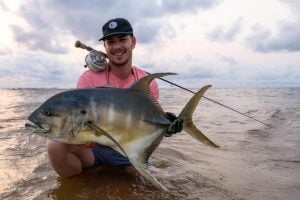
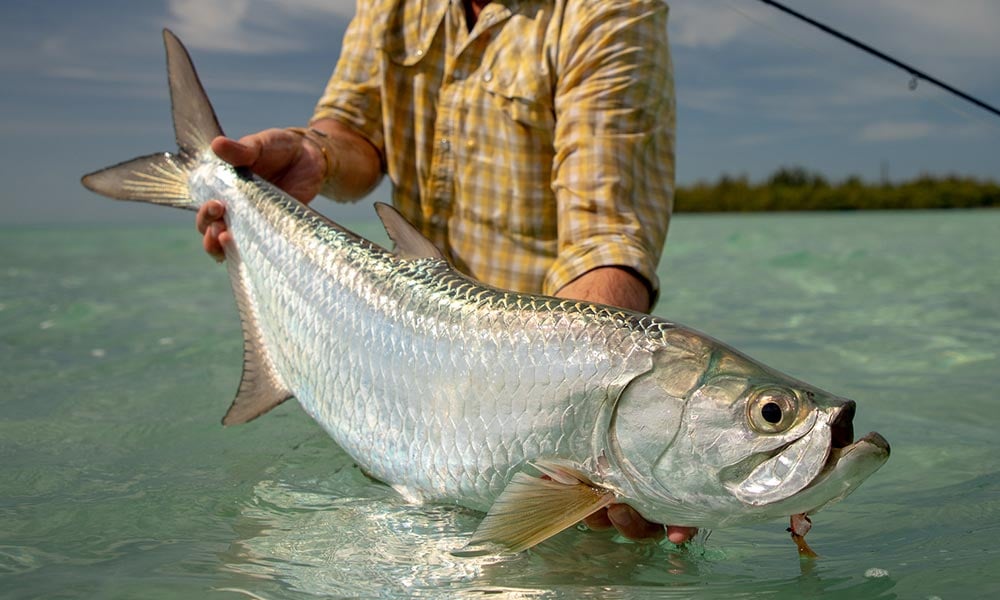
Tarpon are large, elongated fish with a dark blue to greenish-black back and bright silver sides — the reflective flanks that give the species its nickname. Their most distinctive features are disproportionately large eyes, a strongly upturned lower jaw with a hard bony plate, and a single dorsal fin whose last ray extends into a long trailing filament. The scales are large, smooth, and highly reflective — 37 to 42 along the lateral line. The tail is deeply forked and built for power. Juvenile fish typically run 5–30 lbs; migratory adults commonly reach 80–150 lbs, with fish over 200 lbs taken regularly in Florida and West Africa.
Tides, light, and wind all affect tarpon behavior. Calm mornings, incoming tides, and clear conditions consistently produce the best shots.
FishingExplora features tarpon-focused lodges in the Bahamas, Yucatán Peninsula, Colombia, and West Africa — covering both juvenile fisheries and trophy-class locations. Contact lodges directly to discuss program structure, seasonal timing, and availability.
FishingExplora’s editorial content draws on lodge input, guide experience, published field reports, and independent research to help anglers make informed decisions about premium fishing destinations.
Florida, West Africa, and the Yucatán Peninsula are the primary destinations for trophy tarpon. Florida’s late spring migration — particularly around Boca Grande and the Florida Keys — produces the most consistent large-fish fishing. West Africa, including Gabon and Guinea-Bissau, holds the IGFA world record and regularly produces fish over 200 lbs.
Tarpon are not easy to catch on fly. They are wary, strong, and require long accurate casts followed by a strip-set rather than a rod lift — a reflex that takes practice to override. Success depends on timing, tide, light angle, and stealth. Hookup rates are low even on good days, which is part of what makes a landed fish significant.
Fly fishing for tarpon on shallow flats means spotting cruising fish and delivering accurate casts with baitfish patterns well ahead of the fish. Use 10–12 weight rods, floating or intermediate lines, and strip-set firmly on the take. Tarpon have hard mouths — multiple strip-sets are often needed to drive the hook home.
April through July covers the prime window across most destinations. Florida and Mexico see strong spring migrations from late April onward. Gabon and Guinea-Bissau fish best October through April during the dry season. The Bahamas peaks for adult fish May through July in backchannel and creek systems.
Occasionally — juvenile tarpon will strike gurglers or poppers, particularly in low light or calm lagoon conditions. Larger fish generally prefer subsurface presentations near bait schools or in deeper cuts, where a streamer or live bait presented at the right depth and speed is far more consistent.
Migratory adults commonly reach 80–150 lbs, with fish over 200 lbs taken regularly in Florida and West Africa. The IGFA all-tackle world record stands at 286 lbs 9 oz, caught off Guinea-Bissau in 2003. Juvenile fish in backwaters and estuaries typically run 5–40 lbs and are far more accessible to visiting anglers.
We use cookies to improve your experience and enable key features on the platform. You can choose which cookies to allow. Some features may not work fully without consent.