Discover the best bumphead parrotfish destinations, guided trips, and lodge-based experiences worldwide. Explore remote waters and world-class angling with expert local hosts.
No results available
Bumphead parrotfish are among the largest and most challenging fish ever targeted on tropical flats. Found in remote reef systems like the Seychelles, they graze in tailing groups and demand precise presentations, heavy tackle, and nerves of steel.
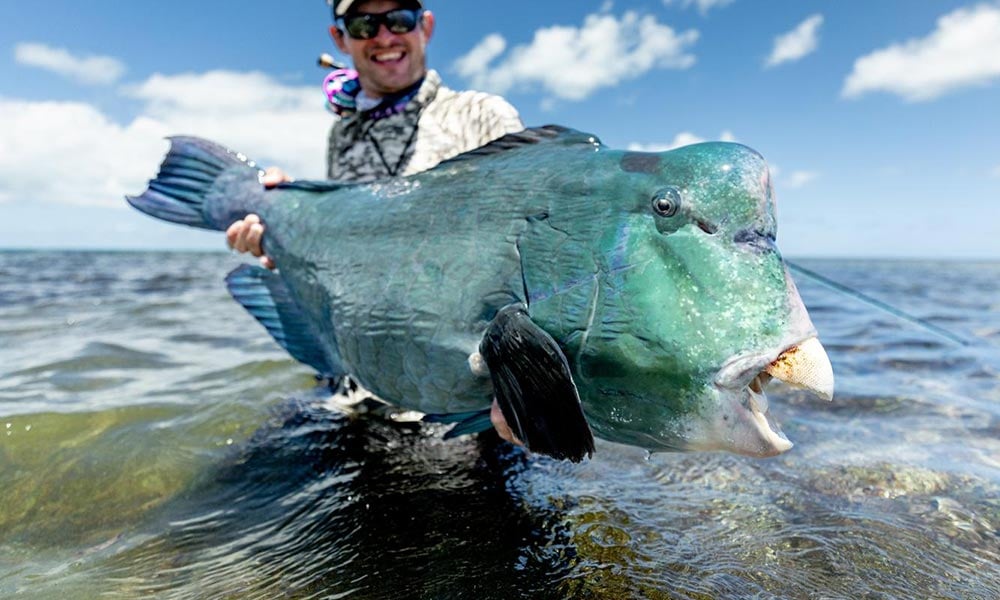
Easily identifiable by their blunt foreheads and massive size, bumpheads (Bolbometopon muricatum) are true reef giants—sometimes exceeding 100 pounds. While they primarily graze on coral and algae, they will occasionally take well-placed crab flies in shallow water. Few fish offer such a visual, slow-motion eat followed by an unstoppable run straight toward coral.
They aren’t a common catch—and most anglers lucky enough to hook one will lose it—but they’ve earned a reputation as the ultimate “unicorn” species for flats anglers seeking a rare, technical challenge.
Farquhar and Cosmoledo atolls offer one of the world’s only consistent opportunities to sight-fish for bumphead parrotfish. Fish feed in groups over turtlegrass and coral rubble, often tailing visibly in 1–2 feet of water. These flats require stealth, accurate casting, and heavy leaders to have any chance of landing one.
In remote island groups such as Palau, Kiribati, and parts of French Polynesia, bumpheads can be seen tailing near reef passes or grazing on shallow coral edges. Angling opportunities are rare and typically incidental.
Along outer reef flats and channels, bumphead parrotfish form large schools, but they are rarely targeted by fly anglers. Most encounters are visual, and opportunities to fish for them are extremely limited.
Bumpheads inhabit large reef systems in this region, particularly in marine protected areas. Though abundant in places, access and fishability remain inconsistent for sport anglers.
Bumphead parrotfish are as frustrating as they are impressive. Their sheer size, slow movement, and feeding behavior give anglers a chance to prepare—but once hooked, they head straight for danger. Tailing in groups like permit, they can be mistaken for rays or small sharks until a closer look reveals their armored heads and sweeping tails. Landing one on fly is rare and celebrated.
These fish are unmistakable: thick bodies with large scales, greenish-blue hues, and a prominent forehead “bump” that develops with age. Their powerful jaws are fused into a parrot-like beak used to scrape coral. Adults commonly range from 40 to 80 pounds, though fish over 100 pounds are possible. When tailing in shallow water, they appear as large, slow-moving shadows with flicks of turquoise and pink in their fins.
Timing is critical—sight-fishing depends on sun angle, tide height, and water clarity. Early incoming tides or low, bright mornings offer the best shots at tailing bumpheads.
FishingExplora currently features guided trips in the Outer Islands of Seychelles, where bumphead parrotfish can be targeted under the right conditions. While they are rarely caught, few species test both skill and gear like this one. These trips offer experienced anglers a real shot at one of the most unique and elusive fish in the shallow saltwater world.
No. They’re rarely caught and even more rarely targeted. But in the Seychelles, especially Farquhar, they’re one of the few places where fly anglers can realistically sight-fish for them.
Bumpheads can exceed 100 pounds, though most caught on fly are in the 40–80 lb range. Their size and strength make them among the most powerful flats fish in the world.
A 12-weight rod, saltwater reel with strong drag, and 100 lb fluorocarbon leader. Flies must be tied on the strongest saltwater hooks available to survive the fight and coral abrasion.
Their first move is always toward coral or rock, and their fused teeth can crush flies or cut through light leaders. Even a well-hooked fish will often break off before reaching the net.
We use cookies to improve your experience and enable key features on the platform. You can choose which cookies to allow. Some features may not work fully without consent.