Discover the best nembwe fishing destinations, guided trips, and lodge-based experiences worldwide. Explore remote waters and world-class angling with expert local hosts.

Zambia, Southern Africa
Catfish, Nembwe, Tigerfish
No results available
The nembwe is one the upper Zambezi’s premier light-tackle predators — a bass-like ambush feeder that hunts tight to structure and fights with its head down. Found through the Zambezi, Okavango, and Kafue systems, it is one of the three species of the Zambezi Grand Slam and a favorite target for fly, lure, and spin anglers working the river’s channels, snags, and reed beds.
The nembwe (Serranochromis jallae) is a large, robust predatory cichlid native to the rivers and floodplains of south-central Africa. It was long treated as a form of Serranochromis robustus and is still widely sold and listed under the common name yellow-belly bream, but a 2020 taxonomic review re-elevated it to a full species. Whatever the label on the page, anglers know it as the upper Zambezi’s hardest-pulling bream — a fish that holds tight to cover and hits a lure or fly with real aggression.
Most nembwe landed run 1–2 kg (around 2–5 lb), with good fish of 3–4 kg (6–9 lb) on productive water and genuine trophies to around 6 kg (13 lb). They are built for short, violent fights rather than long runs. A hooked nembwe bulldogs straight for the nearest snag, shaking its head the whole way, and the angler’s job is to turn it before it buries itself in structure. Pound for pound, few of the Zambezi’s bream fight harder.
The upper Zambezi — the slow, braided stretch above Victoria Falls — is the classic nembwe river and the water most associated with the species among traveling anglers. Larger fish hold in the deep main channels and along the eroded clay banks of the river’s outside bends, while smaller fish work the lagoons, secondary channels, and reed beds. The annual flood cycle drives everything: each year the river spills into vast floodplains, then recedes, concentrating fish and bait back into the channels. The floodplain fishery around the village of Mwandi in southwestern Zambia is among the most productive stretches.
The Okavango holds strong nembwe populations, often caught along the edges of floating hippo grass and around backwaters, eddies, and fallen timber near the bank. Breeding fish from the Okavango show the most vivid coloring of the species’ range — a bright orange marginal band on the dorsal and tail fins, against the creamy-yellow bands seen on upper Zambezi fish.
The Kafue, a major Zambezi tributary running through central Zambia, carries its own resident nembwe population alongside the wider Zambezi-system bream and tilapia. It sees less traveling-angler traffic than the upper Zambezi but holds the same fish in similar channel-and-structure habitat.
Beyond these core fisheries, the nembwe’s natural range extends through the Kasai and Zambian Congo systems and the Cunene River, and it has been introduced to waters including Lake Kariba. For the visiting angler, though, the upper Zambezi and the Okavango remain the destinations that define the fishery.
The nembwe is the Zambezi’s answer to the bass — an ambush predator that uses structure as cover, lying in the lee of submerged trees, reed beds, and current seams before lunging out to take any fish small enough to fit in its mouth. That behavior makes it a genuinely tactical light-tackle target: success comes from reading the structure, placing a lure or fly tight to cover, and provoking a reaction strike.
It is also one of the three species that make up the Zambezi Grand Slam, the unofficial angling treble of tigerfish, nembwe, and sharptooth catfish landed in a single trip — a goal that gives a day on the river a focus beyond the tiger fishing the region is best known for. For fly and lure anglers in particular, the nembwe offers a slower, more deliberate game than the explosive tigerfish, and a stronger fight than its size suggests.
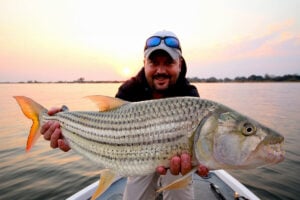
Nembwe are heavy, deep-bodied fish with a large mouth set with widely spaced, conical teeth — the build of a fish that crushes and engulfs prey rather than slicing it. The body is olive to green, often with a darker green band running along the midline toward the tail, coloring that breaks up well against submerged timber and weed. Breeding adults turn yellow-green along the flanks, and the throat and belly take on an intense yellow-orange — the source of the common name yellow-belly bream. The marginal bands on the dorsal and tail fins run creamy-yellow on upper Zambezi fish and bright orange on Okavango fish, and breeding males carry egg-spot markings on the rear of the anal fin.
On the Zambian upper Zambezi, the season is set by law as much as by the river. A sesonal fishing ban closes all fishing — including recreational catch-and-release — from 1 December to the end of February to protect the breeding season, so the fishery effectively runs from 1 March to 30 November. The same ban applies to the Kafue; the Okavango and other systems outside Zambia follow their own rules. Within the open season, the fishing is shaped by the flood cycle:
Water clarity, light, and the state of the flood all shape the fishing day to day, and the precise peak for nembwe and the other bream is best confirmed with the lodge for a given season.
FishingExplora’s current listing for nembwe covers the upper Zambezi in Zambia, where lodges offer guided fishing for nembwe alongside tigerfish, other bream and tilapia species, and catfish. These are typically fly, spin, and lure operations catering to anglers of all levels, with a strong catch-and-release ethos and rods and tackle provided — though fly anglers should generally plan to bring their own fly equipment. Contact lodges directly to plan your trip.
FishingExplora’s editorial content draws on lodge input, guide experience, published field reports, and independent research to help anglers make informed decisions about premium fishing destinations.
The nembwe (Serranochromis jallae) is a large predatory bream — a cichlid — found in the rivers and floodplains of south-central Africa, including the upper Zambezi, Okavango, and Kafue systems. It is also known as the yellow-belly bream, and was long classified as Serranochromis robustus before being re-elevated to a separate species in 2020. Often described by anglers as Africa’s equivalent to bass: an ambush predator that holds to structure and hits lures and flies hard.
The upper Zambezi above Victoria Falls is the best-known nembwe fishery for visiting anglers, followed by the Okavango Delta and the Kafue River. The species also occurs through the wider Congo-system headwaters and the Cunene, and has been introduced to waters such as Lake Kariba. FishingExplora’s current nembwe listing covers guided lodges on the upper Zambezi in Zambia.
Fish tight to structure. Nembwe hold against submerged trees, reed beds, clay-bank ledges, and current seams, so the productive approach is to place a deep-diving crankbait, spinner, jig, or weighted fly right on the cover and work it slowly, with many takes coming as the lure sinks. They can also be taken on drifted bait along channel edges.
A light to medium spinning outfit handles most lure fishing; in the snaggy water where nembwe live, braided line of around 20 lb or heavier helps turn fish before they reach cover. Fly anglers should fish a 7- or 8-weight — enough power to pull a fish clear of structure. A nembwe’s first move when hooked is to dive straight back into the snag, so stopping power matters more than finesse.
Most nembwe run 1–2 kg (around 2–5 lb), with good fish of 3–4 kg on productive water. Genuine trophies reach around 6 kg (about 13 lb), though fish that size are exceptional. They fight well above their weight, bulldogging deep with hard head-shakes rather than running or jumping.
The Zambezi Grand Slam is the unofficial angling achievement of landing the river’s three signature game fish — tigerfish, nembwe, and sharptooth catfish — in a single trip. The nembwe is the bream of that trio, which is part of what makes it a sought-after target on a river best known for its tigerfish.
On the Zambian upper Zambezi, fishing is closed by law from 1 December to the end of February — a ban that covers recreational catch-and-release — so the season runs from 1 March to 30 November. Within that window the fishing follows the flood cycle: the river is high and dropping early in the season, then as the floodplain drains from around June the fish concentrate back into the channels, and the lower, clearer water of the later months is often the strongest period for working lures and flies to structure. The exact peak varies by season and is best confirmed with the lodge.
Nembwe are traditionally valued as a table fish across their range, with firm white flesh, and they support local subsistence and commercial fisheries. On the sport fishery, however, many established operations run a catch-and-release policy to protect fish stocks, releasing nembwe after a quick photo and weight.
We use cookies to improve your experience and enable key features on the platform. You can choose which cookies to allow. Some features may not work fully without consent.