
Discover the best sheefish destinations, guided trips, and lodge-based experiences worldwide. Explore remote waters and world-class angling with expert local hosts.
Bristol Bay, Alaska
Arctic Char, Chinook (King) Salmon, Chum (Keta) Salmon
No results available
Sheefish are one of North America’s most unique and underappreciated gamefish — nicknamed “the tarpon of the tundra” for their size, power, and silver flash. Found only in a handful of Arctic drainages, they offer a rare and genuinely exciting challenge in some of the most remote river environments on the continent.
Large, elusive, and capable of strong runs and acrobatic leaps, sheefish — also known as inconnu — are typically targeted in broad Arctic river systems during summer. Their habitat overlaps with some of the most pristine and inaccessible regions in Alaska, requiring fly-out or boat access to reach. While not widely known outside the serious angling community, they are deeply valued by those who’ve encountered them.
Though most often caught on spinning gear with jigs and spoons, sheefish can also be pursued on the fly, especially where fish are stacking at the seams between clear tributaries and silt-laden mainstem rivers — an approach that has produced increasingly consistent results in recent years. They are the largest member of the whitefish subfamily and among the last truly wild freshwater predators in the North American Arctic.
Sheefish are native to Arctic and sub-Arctic rivers and lakes, migrating long distances — sometimes over 1,000 miles — within a single summer between feeding and spawning areas.
Alaska is the primary sport fishing destination for sheefish. Key systems include the Kobuk, Selawik, Kuskokwim, and Yukon River drainages. The largest fish are found in the Selawik-Kobuk area of northwestern Alaska, where the Alaska sport record of 53 lbs was set on the Wulik River. Fish stack at the confluences of clear tributaries with the silt-laden mainstem rivers, feeding on juvenile salmon, cisco, and whitefish pushing out of the tribs. Most access requires bush plane or boat travel.
Sheefish combine genuine rarity with impressive size and behavior. Their chrome appearance, broad forked tails, and aggressive strikes give them a saltwater-like quality — hence the “tarpon of the tundra” nickname. Unlike most whitefish, they are exclusively predatory as adults, hunting open water for baitfish rather than foraging on the bottom. They do not die after spawning, meaning large fish accumulate over many years. For anglers who value isolation, wilderness, and a truly uncommon target, sheefish are hard to match.
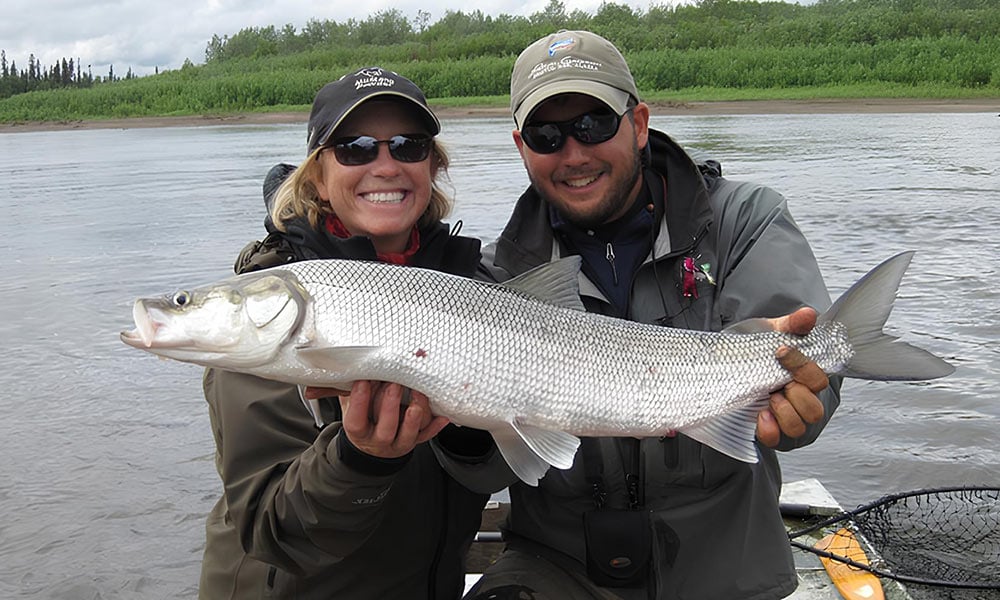
Sheefish are long, silvery fish with a pale green or blue-grey back, white sides, large scales, and no spots — a clean, chrome appearance that sets them apart from other northern species. The lower jaw protrudes beyond the upper, giving them a distinctive, slightly gaping mouth lined with small, densely-packed teeth — built for seizing baitfish rather than sipping insects. The tail is deeply forked. In the water they look, and often behave, more like a saltwater species than a freshwater one.
FishingExplora lists lodges where you can fish for sheefish in Alaska. Listings cover program structure, access, season dates, and direct contact with the lodge.
FishingExplora’s editorial content draws on lodge input, guide experience, published field reports, and independent research to help anglers make informed decisions about premium fishing destinations.
Alaska is the primary destination, with the Kobuk and Selawik rivers in northwestern Alaska producing the largest fish. The Kuskokwim and Yukon systems also hold good populations. Nearly all productive sheefish water requires bush plane or boat access — this is not roadside fishing. The Selawik-Kobuk area consistently produces the biggest fish, with the Alaska sport record set at 53 lbs.
In most Alaska river systems sheefish average 15 to 30 lbs, but the Selawik-Kobuk area of northwestern Alaska consistently produces fish well above that range. The Alaska sport record stands at 53 lbs. Fish do not die after spawning, so large individuals accumulate over many years — making trophy potential genuine rather than theoretical in the right systems.
Yes — sheefish respond to baitfish-style streamers fished slow and deep on fast-sinking lines. Spin fishing is more common and often more practical in silt-laden water, but fly anglers do well on clearer tributaries where fish are actively feeding. Sturdy leaders and large streamer hooks are necessary — sheefish have strong jaws and small, dense teeth that can abrade light tippet.
Unlike grayling, which rise to insects, or lake trout, which hug structure, sheefish are active open-water hunters that chase baitfish through main river channels and tributary confluences. Their take is aggressive and unmistakable. They also survive multiple spawning seasons unlike Pacific salmon, meaning older, larger fish are always present in the system. Their behavior and profile genuinely resemble a saltwater predator more than a freshwater one.
Yes — Alaska imposes bag and possession limits on sheefish that vary by river system and region, reflecting the species’ limited range and the importance of conserving spawning populations. Regulations can change year to year. Always check current Alaska Department of Fish and Game rules specific to the system you plan to fish well before your trip, as some drainages have stricter limits than others.
Late June through August is the most productive window in Alaska, when fish are actively feeding on migrating baitfish and accessible in main river systems. July tends to offer the most stable conditions. The peak feeding period coincides with juvenile salmon and whitefish pushing out of clear tributaries into the mainstem rivers — timing a trip around this movement produces the most consistent results.
Sheefish are more mobile than either — they cover large amounts of water rather than holding tight to structure like lake trout or ambushing from cover like pike. The most productive approach is covering tributary confluences and river seams rather than fishing specific structure. Their fight has more in common with a large salmon than a pike — powerful, sustained runs with occasional jumps rather than short, violent bursts.
We use cookies to improve your experience and enable key features on the platform. You can choose which cookies to allow. Some features may not work fully without consent.


