Discover the best steelhead fishing destinations, guided trips, and lodge-based experiences worldwide. Explore remote waters and world-class angling with expert local hosts.
No results available
Steelhead are migratory rainbow trout that return to freshwater rivers from the ocean or Great Lakes to spawn. Known for their power, aerial fights, and unpredictable nature, they’re among the most iconic species in freshwater fly fishing.
Unlike resident rainbow trout, steelhead (Oncorhynchus mykiss) live part of their life in saltwater (or in large freshwater systems like the Great Lakes), growing big before making upstream spawning migrations. Their nomadic lifecycle creates fish that are not only physically strong, but also mentally elusive—requiring both patience and precision to catch.
Steelhead fisheries are defined by seasonality and flow. They often enter rivers in fall, winter, or spring depending on the system. Anglers must time their trips to fresh pushes of fish and learn to read water movement, temperature swings, and even moon phases. When everything aligns, a steelhead grab is unforgettable.
Alaska’s steelhead runs are concentrated in the Southeast and Kodiak Island, where wild fish return in late summer and fall. These fisheries are boat or fly-in only, offering a mix of solitude and big fish in jungle-like river systems.
BC is steelhead country. From the Dean and Bulkley to the Skeena and Kispiox, these rivers are known for their size, scenery, and powerful fish. Fall runs dominate, with two-handed rods and swung flies the standard approach.
Though not technically “steelhead” by genetics, southern Argentina hosts strong sea-run rainbow trout runs in rivers like the Santa Cruz. These ocean-fed fish behave much like Pacific steelhead and offer big-fish potential in a wild setting.
Steelhead blend the best of both worlds: the acrobatic power of a salmon with the feeding instincts of a true trout. Born in freshwater but hardened by time in the ocean, they return with speed, stamina, and a drive to move upriver through heavy flows. Few fish test gear and technique like a fresh chrome steelhead in big water.
What makes them truly special, though, is the commitment they demand. These fish are elusive—requiring patience, sharp water reading, and persistence over days, not hours. Whether winter or summer-run, steelhead are a thinking angler’s fish. It’s not about high numbers; it’s about the one that commits.
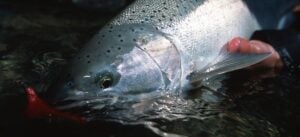
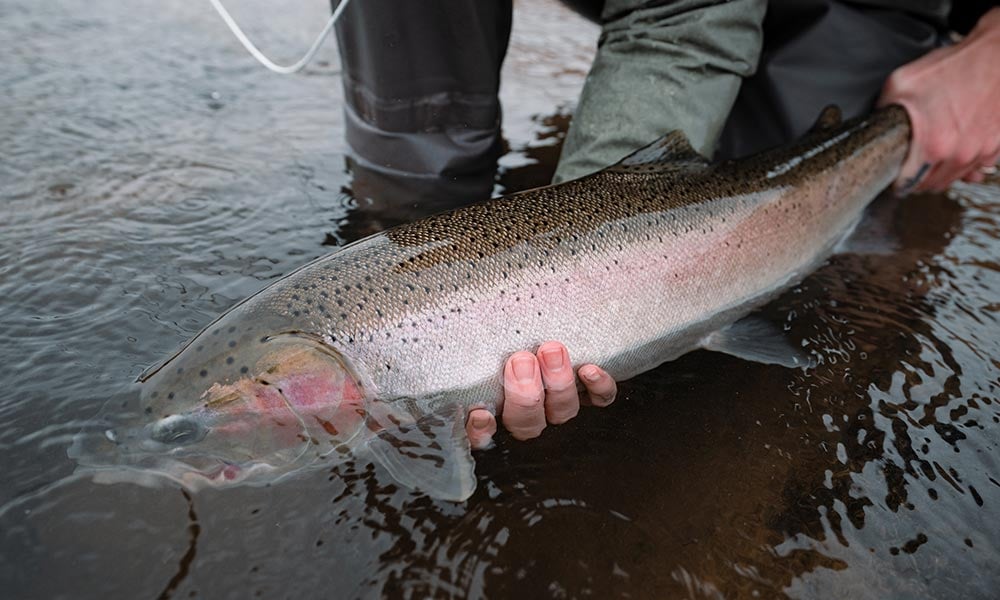
Fresh steelhead are bright silver with metallic sides and a subtle bluish or greenish back. As they spend time in freshwater, they darken and may display a pink to red band along the lateral line—especially in males. Spawning fish often show green backs, dark cheeks, and pronounced kypes. Compared to resident rainbows, they are more elongated and powerful, built for long-distance migrations and fast water.
Seasonal flow, water temperature, and moon cycles often determine timing. Swinging flies on the drop or nymphing on rising water can both be productive depending on the river.
FishingExplora connects anglers to some of the world’s best steelhead fisheries. From the classic rivers of British Columbia to fly-out wilderness camps in Alaska, our partner lodges provide access to remote runs, expert guides, and the tactical support needed for this highly technical fishery. Every trip is vetted for access, seasonality, and fishing quality—so you can focus on that one perfect grab.
Steelhead are the anadromous (migratory) form of rainbow trout, meaning they live part of their life in the ocean (or Great Lakes) and return to freshwater to spawn. Resident rainbow trout stay in freshwater their entire lives. Steelhead tend to be larger, more powerful, and more migratory in behavior.
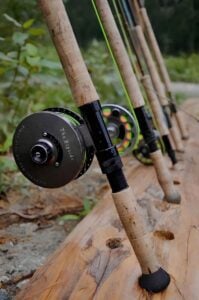
Swinging flies with a two-handed rod (Spey fishing) is the classic and most popular approach in BC and Alaska. However, nymphing and egg-drifting can also be productive in certain conditions, especially in colder water.
Peak steelhead season in British Columbia runs from late August through November, depending on the river. Some rivers see early runs, while others peak with fall rains.
No. Steelhead are native to the North Pacific Rim. However, sea-run rainbow trout introduced to Argentina have established runs that behave similarly to steelhead, especially in the Santa Cruz River system.
Steelhead take a variety of fly patterns depending on water conditions and season. Proven choices include Intruders, Egg Sucking Leeches, Hoh Bo Speys, and beadhead nymphs like stoneflies or glo-bugs. In low, clear water, small traditional wet flies and sparsely dressed soft hackles often outperform larger patterns.