Discover the best sea-run brown trout fishing destinations, guided trips, and lodge-based experiences worldwide. Explore remote waters and world-class angling with expert local hosts.
Tierra del Fuego, Argentina
Sea Trout, Sea-Run Brown Trout
Western Region, Iceland
Arctic Char, Atlantic Salmon, Sea Trout
Tierra del Fuego, Argentina
Sea Trout, Sea-Run Brown Trout
No results available
Sea-run brown trout migrate between salt and freshwater, returning to rivers to spawn after feeding seasons at sea. Their nocturnal habits, tidal movements, and selective behavior make them a technically demanding target — and one of the most rewarding in fly fishing.
Among the most revered quarry in the fly fishing world, sea-run brown trout (Salmo trutta) combine the selectivity of a trout with the power of a migratory species. In the UK and Europe the same fish is commonly called “sea trout” — both terms refer to the same species, with usage varying by region and fishing tradition.
Targeting sea-run browns demands precise timing, sharp water-reading, and a flexible approach. Their behavior shifts with tides, river levels, and light conditions, and success often comes down to adapting in real time.
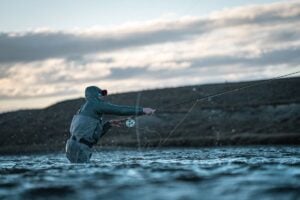
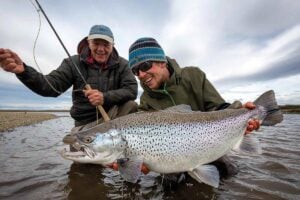
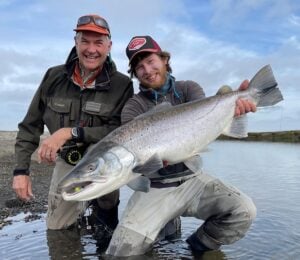
The Río Grande is the primary destination for trophy-sized sea-run browns. Introduced in 1935, the population has thrived on the biological richness of the South Atlantic — a University of Montana study puts the average fish at over 9 lbs, with 15-lb fish common and 20-lb fish released every week of the season. The Río Gallegos to the north also holds quality fish. Both rivers run through open steppe and require long casting, strong-wind management, and methodical presentation in tidal zones and deep channels.
For more on how the Río Grande fishery works, see our guide to sea-run brown trout fishing in Argentina.
Iceland’s sea-run trout rivers offer crystal-clear water and defined seasonal runs from late June through early September. Fish return to both east and west coast systems, with fishing concentrated around estuary mouths, riffles, and swing-friendly mid-river pools.
Along Norway’s coast, sea-run browns push into glacial rivers where tides meet fresh water, often requiring two-handed rods in strong current. Sweden’s southern shorelines and Denmark’s island rivers offer consistent runs, particularly in spring and autumn, with estuary and beach fly fishing common early in the season.
Scottish rivers including the Teith, Awe, Tweed, and Spey carry reliable runs. The main migration begins in May with larger fish in the 3–8 lb range, followed by the bulk of shoal fish — typically 1–3 lbs — entering systems in June and July. Many loch systems also hold sea-run fish in upper tributaries.
Sea-run browns return to rivers across the south and west, including the Itchen, Tamar, and Hampshire Avon. These fisheries reward stealth and are most productive during summer nights when fish are less wary and more likely to move.
The Dovey, Towy, and Moy are well-established sea trout rivers. In Wales the fish are known locally as sewin; in Ireland, as white trout. Night fishing with floating lines and surface patterns is the traditional approach on these systems.
Access to a rich marine diet drives growth that river-resident fish cannot match. How large they grow depends heavily on where they fish: on the Río Grande, a fish returning after four spawning cycles regularly exceeds 20 lbs. In European river systems, the typical river fish runs 1–3 lbs, with faster-growing strains on rivers like the Tywi and Tweed producing fish of 5–8 lbs.
Beyond size, it is the combination of power, selectivity, and conditions that makes them compelling. Their behavior is tied to tides, moon phases, and light levels in ways that resident trout fishing is not. A sea-run brown that has spent months feeding on baitfish in the ocean fights differently from anything else on a fly rod.
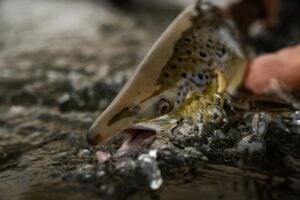
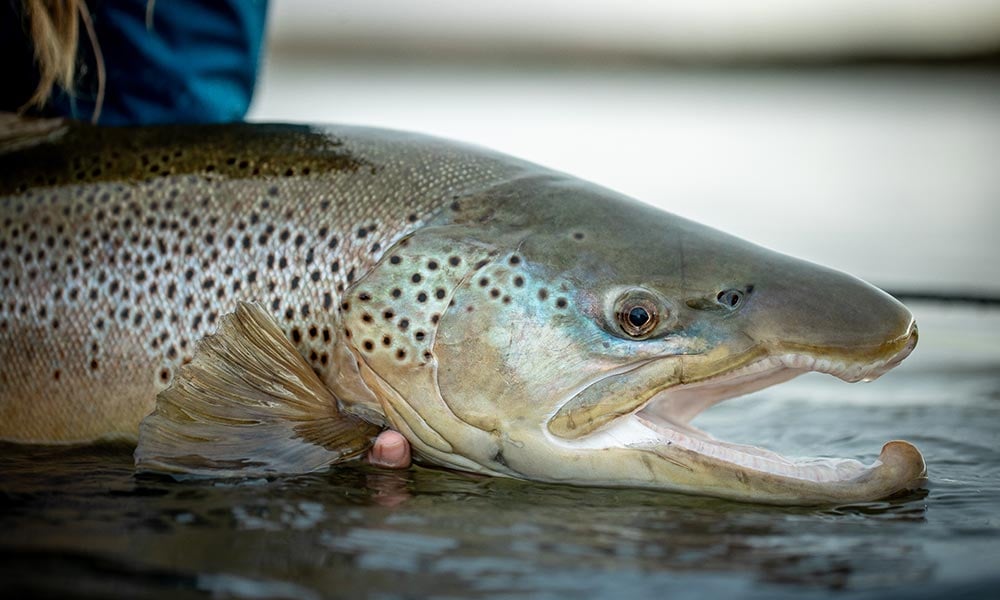
Fresh from the sea, these fish are chrome-silver with a streamlined build and minimal visible spotting — smaller fish in particular can look like little more than a bright, silvered trout. Their backs carry a blue-grey or olive hue; their bellies are white. Sea lice on a fresh-run fish are a reliable indicator of recent salt water.
As they spend time in freshwater, the silver fades and they gradually revert to the coloration of a resident brown trout — dark spots re-emerging along the flanks and gill plate — making identification increasingly difficult the longer they have been in the river. During the spawn, males develop a slight kype and bronze-gold tones.
FishingExplora’s current lodge relationships cover Tierra del Fuego and Iceland — the destinations where the largest fish and the most structured lodge programs are concentrated. European fisheries are listed here for reference.
FishingExplora’s editorial content draws on lodge input, guide experience, published field reports, and independent research to help anglers make informed decisions about premium fishing destinations.
No — both refer to the same species, Salmo trutta. “Sea trout” is the standard term across the UK and Europe; “sea-run brown trout” is more common in Argentina, North America, and scientific literature. The population on the Río Grande in Tierra del Fuego is often considered a separate ecological standout — the fish there grow substantially larger due to longer ocean feeding cycles and the biological richness of the South Atlantic.
The Río Grande in Tierra del Fuego, Argentina. A University of Montana study puts the average fish at over 9 lbs, with 15-lb fish common and 20-lb fish released every week of the season — no other river produces trophy-class sea-run browns with the same consistency. Iceland offers the next best combination of fish size, water quality, and reliable access.
Sea-run browns have a more rounded tail, a shorter head profile, and spotting along the flanks — particularly red or brown spots near the gill plate and below the lateral line. Atlantic salmon typically have a more forked tail, longer jaws, and fewer spots below the lateral line. In the hand, sea-run browns also tend to be more thickly built relative to their length. Fresh-run fish of both species may carry sea lice, so lice alone are not a reliable identifier.
Generally yes. Their migratory nature makes them condition-dependent and transient — present in fishable numbers only during defined seasonal windows. Behavior shifts with tides, light, and river levels in ways that resident fish do not. In low, clear water or on pressured systems, they can become highly selective and difficult to move.
On the Río Grande and larger Icelandic and Scandinavian rivers, two-handed rods of 12–14 feet in 8- or 9-weight are the practical standard — they handle wind, cover wide pools, and turn over large tube flies on sink tips. A single-handed 7- or 8-weight covers tighter European rivers. Carry floating lines, intermediate heads, and a selection of sink tips; a full Skagit setup with interchangeable tips handles high or fast water conditions.
It depends on the fishery. In UK and Irish rivers, night fishing is a very common practise — sea-run browns become significantly more active and less wary after dark, and surface patterns can be highly effective in summer pools. On the Río Grande, fishing is during daylight hours, with the most productive windows in early morning and late evening when fish move between holding lies.
We use cookies to improve your experience and enable key features on the platform. You can choose which cookies to allow. Some features may not work fully without consent.