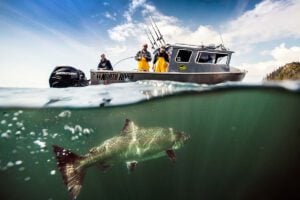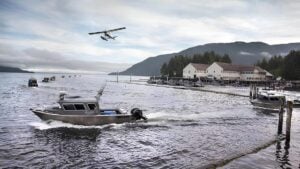
Explore fishing trips in Southeast Alaska, staying at carefully selected lodges that combine expert guiding, remote wilderness settings, and exceptional angling.

No results available
Southeast Alaska — the panhandle — stretches roughly 500 miles from Prince of Wales Island in the south to Yakutat in the north, encompassing over 1,000 islands, the protected channels of the Inside Passage, and some of the most productive saltwater and freshwater fishing on the Pacific coast. The region’s defining character is variety: king and coho salmon, halibut, lingcod, rockfish, and wild steelhead all within reach of lodge-based programs, often in the same week.
The Tongass National Forest — the largest national forest in the United States at around 17 million acres — forms the backbone of Southeast Alaska’s wilderness. Most towns and lodges are accessible only by air or sea, and the region’s protected marine waters allow boats to operate in conditions that would be impossible on the exposed outer coast of the Gulf of Alaska. That sheltered access is central to how Southeast fishing lodges are structured: boats leave the dock daily for salmon and halibut grounds that are often minutes away, with freshwater fly-out options adding stream-caught coho and steelhead to the mix.
Unlike Bristol Bay, Southeast Alaska is not primarily a fly fishing destination. The dominant fishing style is saltwater boat-based — trolling, mooching, and jigging for king and coho salmon, bottom fishing for halibut and lingcod, and working rockfish structure in protected channels. Freshwater fishing exists throughout the region, including fly-out streams for coho and steelhead, but most lodge programs are built around the marine fishery first. Anglers who want both can find lodges that run saltwater days alongside freshwater fly-out options in the same week.
For those comparing different lodge formats across Southeast Alaska — saltwater boat programs, fly-out freshwater operations, and mixed saltwater and freshwater lodges — see our Editorial Guide to Alaska Fishing Lodge Programs, which explains how these programs differ and how to choose the right fit.
The southern gateway to Southeast Alaska, Ketchikan bills itself as the salmon capital of the world and backs the claim with consistent multi-species fishing from May through September. Prince of Wales Island — roughly 140 miles long and the third largest island in the United States — sits just west of Ketchikan and offers some of the most lodge-dense saltwater fishing in the region.
King salmon run from mid-June through July, with coho arriving from July through September. Halibut are available all season. The island’s outer coast exposure and position on the main Pacific salmon migration route give lodges here access to fish that are ocean-bright and aggressive. Numerous small streams and lakes on the island support freshwater coho, cutthroat trout, Dolly Varden, and steelhead for anglers wanting a mixed program.
Sitka sits on the outer coast of Baranof Island, directly on the main migratory route for Pacific king salmon moving north from their wintering grounds in the North Pacific. ADF&G data consistently shows Sitka with the highest saltwater king salmon catch rates in Alaska — a function of its outer coast position and the volume of fish passing through before dispersing to inland river systems.
Halibut fishing in Sitka Sound is strong throughout the season, with varied bottom structure supporting large fish. Freshwater options include remote fly-out streams on Baranof and neighbouring islands, accessible by floatplane from town, targeting coho, pink salmon, cutthroat trout, and Dolly Varden.
The central Inside Passage around Petersburg and Wrangell offers sheltered saltwater fishing for all five Pacific salmon species alongside halibut, lingcod, and rockfish. The Stikine River — one of the few major North American rivers to breach the Coast Mountains — enters the Inside Passage near Wrangell and stages significant king and coho salmon runs.
Petersburg’s position at the northern end of Wrangell Narrows gives lodge-based anglers access to a wide range of marine habitats. This part of Southeast sees less lodge traffic than Ketchikan or Sitka, which can mean less crowded water on productive days.
Yakutat sits at the northern edge of Southeast Alaska where the panhandle meets the Gulf of Alaska, operating as a genuinely distinct fishing destination from the rest of the region. The Situk River sustains the largest wild steelhead run in Alaska, averaging over 7,000 fish annually according to ADF&G weir counts, with spring-run fish entering from April through May. All five Pacific salmon species also run through summer. Offshore, Yakutat Bay produces halibut, king salmon, lingcod, and rockfish for anglers combining river and saltwater days.
Southeast Alaska lodges typically operate from May through September, with year-round fishing possible in some saltwater areas. Timing depends heavily on your target species. For a full breakdown of how salmon runs move through Alaska’s regions month by month, see our guide to the best months for salmon fishing in Alaska.
FishingExplora connects anglers with carefully selected lodge operators across Southeast Alaska — from saltwater-focused programs on Prince of Wales Island and Baranof Island to mixed freshwater and saltwater operations. You can contact hosts directly and plan your program from here.
For more lodge-based options across Alaska’s regions, see our Alaska fishing lodges page.
FishingExplora’s editorial content draws on lodge input, guide experience, published field reports, and independent research to help anglers make informed decisions about premium fishing destinations.
Saltwater salmon and halibut fishing are the defining attraction. King salmon run from May through July, with Sitka recording the highest saltwater king catch rates in Alaska. Coho follow from July through September. Halibut are available throughout the season across all lodge hubs. Yakutat adds a freshwater dimension with the Situk River — the largest wild steelhead run in Alaska — making it a standout destination for spring steelhead from April through May.
It depends on what you mean by fly fishing. The primary lodge programs are boat-based saltwater fishing, not fly fishing. However, most lodge hubs offer floatplane access to remote freshwater streams for coho salmon, cutthroat trout, Dolly Varden, and steelhead — all of which can be targeted with a fly rod. Yakutat is the standout fly fishing destination in Southeast, with the Situk River’s steelhead run drawing dedicated fly anglers from April through May each year.
June and July are the peak months for king salmon across most of the region, with Sitka particularly strong through mid-July. August is the best month for coho salmon in both saltwater and freshwater. For steelhead on the Situk River at Yakutat, April and May are the prime window. Halibut fishing is reliable from May through September throughout Southeast.
Access varies by lodge location. Most are reached by floatplane or scheduled float service from the nearest hub town — Ketchikan, Sitka, Juneau, or Yakutat. Some Prince of Wales Island lodges are also accessible by ferry or water taxi. Lodge programs typically coordinate in-region transfers as part of arrival logistics. All four towns have commercial air service connecting to Anchorage and Seattle. Lodge programs typically coordinate in-region transfers as part of arrival logistics.
For saltwater salmon and halibut fishing, most anglers use conventional tackle — light to medium spinning or trolling rods are standard on lodge boats. For freshwater fly fishing, a 7- or 8-weight handles coho salmon and cutthroat trout in most stream conditions. Steelhead is typically fished with an 8-weight single-hand or a lighter spey rod, with sink tips for swinging flies in the heavier flows.
We use cookies to improve your experience and enable key features on the platform. You can choose which cookies to allow. Some features may not work fully without consent.