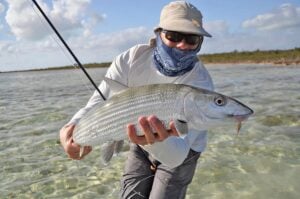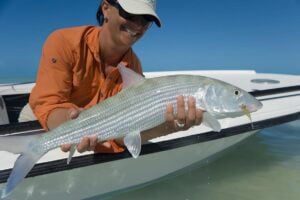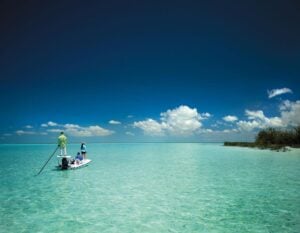
Explore fishing trips in Mangrove Cay, staying at carefully selected lodges that combine expert guiding, remote wilderness settings, and exceptional angling.

No results available
Mangrove Cay sits at the geographical center of Andros, overlooking the North, Middle, and South Bights — a vast interconnected system of tidal flats, creeks, and channels that serious bonefishing guides consider the most productive bonefish water in the world. The guides here grew up on these flats. Three and four generations of the same families have been reading these tides, and that accumulated knowledge is not something a visiting angler finds anywhere else in the Caribbean.
Andros is widely regarded as the Bonefish Capital of the World, and Mangrove Cay sits squarely in its prime water. The island’s unique geography gives lodges here a practical advantage found nowhere else in the Bahamas: opposing tidal systems on the east and west sides of the island mean there is almost always productive, fishable water within reach of the dock. When the Bights are running one direction, the ocean flats on the east side are running the other — guides adapt in real time, keeping anglers on fish through almost any weather pattern.
The remote West Side of Andros — known among serious bonefishing anglers as the Land of the Giants — adds another dimension entirely. Reached by a short run from the Mangrove Cay dock, the West Side channels hold some of the largest bonefish on the island, with double-digit fish a realistic seasonal expectation for anglers prepared to put in the time on less-pressured water.
For a full comparison of Bahamas fishing lodge programs including Mangrove Cay, see our Editorial Guide to Bahamas Fishing Lodge Programs.
The Bights of Andros form the heart of the island’s bonefishing fishery — a sprawling network of tidal flats, mangrove-edged creeks, and shallow channels stretching across the central section of the island. Each Bight has its own character: the North Bight tends toward broader, more open flats suited to skiff-based sight fishing; the Middle and South Bights offer tighter creek and channel systems where fish stack during tidal transitions. Lodges on Mangrove Cay can reach all three within minutes of the dock, running a rotation that follows fish movement through the tides rather than being locked into a single beat system.
The West Side of Andros is remote by Bahamian standards — a run from the Mangrove Cay dock that takes guides out to ocean-side flats and channel edges where fishing pressure is minimal and fish sizes reflect it. Bonefish here regularly push into double digits, and the combination of less-pressured water and larger average fish size makes it the destination within a destination that serious trophy hunters plan their weeks around. Conditions on the West Side are more exposed than the sheltered Bights, so guides make the call based on wind and swell — when it’s fishable, it’s worth it.
The eastern shore of Mangrove Cay offers hard-sand flats suited to wading when tides and bottom conditions allow. These flats produce consistent action on the incoming tide as bonefish push up from deeper edges onto the flat to feed. The mangrove creek systems adjacent to the main fishing areas concentrate fish during tide transitions and offer protected casting when trade winds make open-water skiff fishing difficult.
FishingExplora lists carefully selected bonefishing lodges on Mangrove Cay with direct access to the Bights and West Side of Andros. Contact hosts directly to discuss program structure, guiding approach, and availability.
For more lodge options across the island chain, see our Bahamas fishing lodges page.
FishingExplora’s editorial content draws on lodge input, guide experience, published field reports, and independent research to help anglers make informed decisions about premium fishing destinations.
Location and tidal access. Mangrove Cay sits at the center of Andros, giving lodges direct access to the North, Middle, and South Bights as well as the ocean-side flats and the remote West Side — all within a short run from the dock. The opposing tidal systems on the east and west sides of the island mean guides can almost always find productive water regardless of conditions, which is a genuine operational advantage over lodges based at either end of the island. The guiding culture here is also distinctly deep-rooted — multi-generational guide families whose knowledge of these specific flats and tides is unmatched anywhere in the Bahamas.
The West Side refers to the ocean-facing flats and channel systems on the western shore of Andros, accessible by boat from Mangrove Cay. It sees considerably less fishing pressure than the Bights, and fish sizes reflect that — double-digit bonefish are a realistic expectation for anglers who make the run out there. Known informally among serious bonefishing anglers as the Land of the Giants, it is more exposed to open-water conditions than the sheltered Bights, so guides make the call on West Side days based on wind and swell. When conditions allow, it is some of the most productive trophy bonefish water in the Bahamas.
An 8- or 9-weight is the guide-recommended standard. Andros can be windy, particularly through the winter and spring months when trade winds run consistently, and anything lighter than an 8-weight becomes a liability when you need to deliver a fly accurately at distance into a crosswind. Bring two outfits if you can. A 10-weight is worth packing if tarpon or permit are part of your program.
October through June covers the full productive season, with December through April producing the most consistent results. February and March are the most sought-after weeks — fish are numerous, sizes tend to be larger in the cooler water, and conditions are generally calmer than the winter trade wind period. Prime weeks book a year or more in advance at the best lodges.
Standard Andros bonefish flies are Gotchas, Crazy Charlies, and Mantis Shrimp patterns in sizes 2–4, in tan, pink, and olive. Local guide-tied variations are often the most effective — most lodges carry these and guides will advise on the day based on conditions and water depth. Bring a selection in different weights to match varying depth and wind. For tackle, an 8- or 9-weight rod with a quality large-arbor reel and at least 200 yards of 20 lb backing is the working standard. Floating line with a long fluorocarbon leader — 9 to 12 feet tapering to 12 lb — covers most Bights situations. Quality polarized glasses rated for bright tropical light are non-negotiable; flats boots and sun protection for full-day exposure complete the kit.
Most anglers fly into Nassau and connect to Mangrove Cay via short domestic flight or boat transfer. Lodges typically coordinate transfers as part of the arrival logistics — confirm the preferred routing when booking. Build in a buffer around interisland connections, which can be affected by weather. The journey from Nassau to the lodge dock is generally straightforward, but the remoteness of central Andros means contingency planning around travel days is worthwhile.
Andros has the largest average bonefish size in the world. Across the Bights system fish typically run 3–5 lbs, with regular appearances of fish in the 6–10 lb range. Trophy fish in the 11–13 lb range are caught each season, predominantly on the less-pressured West Side channels and deeper tidal edges. Double-digit bonefish — fish above 10 lbs — are a realistic target for serious anglers who dedicate time to the West Side, and Andros produces more fish in this size class annually than almost any other destination in the Bahamas.
We use cookies to improve your experience and enable key features on the platform. You can choose which cookies to allow. Some features may not work fully without consent.