Discover the best Lenok (Asian Trout) destinations, guided trips, and lodge-based experiences worldwide. Explore remote waters and world-class angling with expert local hosts.

Northern Mongolia
Grayling, Lenok (Asian Trout), Taimen
Northern Mongolia
Grayling, Lenok (Asian Trout), Taimen
Northern Mongolia
Lenok (Asian Trout), Taimen
No results available
Lenok are ancient, hard-hitting salmonids native to Asia’s cold rivers and highland streams. Found from Mongolia to the Russian Far East, these aggressive feeders strike streamers, dry flies, and even mouse patterns, offering consistent action in some of the most remote wilderness fisheries on earth.
Lenok (also called Asian trout) are salmonids of the genus Brachymystax, known for their speckled flanks, strong fights, and opportunistic feeding behavior. Two species share many of Mongolia’s northern river systems — the sharp-snouted lenok (B. lenok) and the blunt-snouted lenok (B. tumensis) — and are often encountered alongside taimen in the same water. They bring their own appeal to anglers, particularly those seeking dry fly action in pristine, lightly pressured rivers.
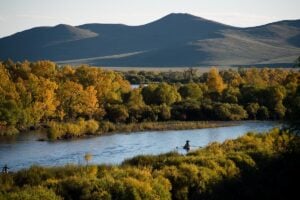
Mongolia’s Eg-Uur, Delgermörön, and Onon rivers hold strong lenok populations. Clear flows, low angling pressure, and prolific insect life make this one of the top global destinations for fly fishing Asian trout. Lenok are present across all major watersheds — from the Shishged in the northwest to the Chuluut in central Mongolia.
Siberian and Russian Far East rivers hold strong lenok populations across a vast range. These fisheries are rarely accessed and often require float trips or helicopter-supported expeditions, where lenok are a consistent secondary target alongside taimen and grayling.
Lenok are found across northern China, particularly in the Amur basin of Heilongjiang and in mountain river systems further west. Some highland rivers offer solid fishing during ice-free months, though logistics can be demanding and populations in many areas face pressure from habitat degradation.
Kazakhstan holds verified lenok populations in the Irtysh basin and at Markakol Lake in the Altai region, where the closely related B. savinovi is found. Cold, fast-flowing mountain rivers in the region offer summer fishing when glacial runoff settles.
South Korea holds the world’s southernmost lenok population, found in high mountain streams in the northeast of the country, particularly in the Gangwon region. Populations are under severe pressure from deforestation and habitat loss and are considered on the verge of extinction. This is not a practical fishing destination — the section is included for completeness of range.
Lenok combine the visual appeal of a wild brown trout with the aggression of a streamer-chaser. Native to cold rivers across Siberia, Mongolia, and parts of northern Asia, they feed opportunistically on flies, lures, and rodent patterns alike. Their readiness to rise in remote, untouched water makes them a consistent draw for anglers who have come for taimen and find the lenok fishing more than holds its own.
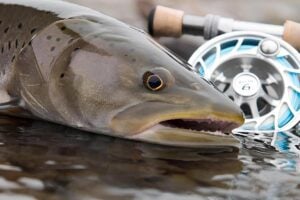
Lenok have a golden-brown to olive body with scattered dark spots and faint red markings along the sides, particularly toward the lateral line and tail. The head is elongated with a distinctive downward-pointing mouth — often described as an underbite — which gives them an immediately recognizable profile among salmonids. Fins are often tinged with orange or amber, especially in mature fish, and spawning fish develop more vivid coloration across the body. In clear freestone streams, the overall impression is closer to a well-marked brown trout than most anglers expect.
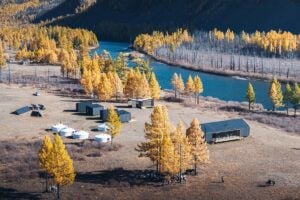
FishingExplora features wilderness expeditions focused on Mongolia’s northern river systems, where lenok share water with taimen and grayling across hundreds of kilometers of protected river. These trips offer low angling pressure, healthy fish populations, and experienced local guides on float or wade access water.
FishingExplora’s editorial content draws on lodge input, guide experience, published field reports, and independent research to help anglers make informed decisions about premium fishing destinations.
Lenok are not true trout but are closely related — both belong to the family Salmonidae. Lenok are classified in the genus Brachymystax, which sits within the same subfamily (Salmoninae) as trout, salmon, and char. They share the body plan, cold-water habitat preference, and feeding behavior of trout, and are widely known as Asian trout or Manchurian trout in common usage. The key distinction is taxonomic — lenok occupy their own genus rather than the genus Salmo or Oncorhynchus that defines true trout.
Yes — lenok rise readily to dry flies, particularly during the summer hatch window in Mongolia and parts of Siberia. Surface action is consistent throughout the day during stable mid-season conditions, and lenok are less selective than most trout species. Standard attractor patterns and caddis imitations work well; on Mongolia’s northern systems, pods of surface-feeding lenok are a reliable feature of afternoon fishing throughout July and August.
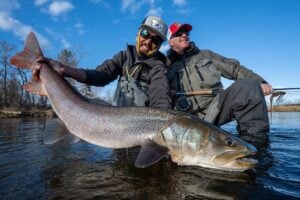
Lenok on Mongolia’s productive northern systems average 40 to 60 cm (roughly 16 to 24 inches), with trophy fish reaching 70 cm (28 inches) and occasional reports of 30-inch fish on the most prolific rivers. Size varies by drainage — lake-connected populations and the slower, richer reaches of larger rivers tend to produce the biggest fish. FishBase records a maximum published length of 70 cm for B. lenok.
Yes — most rivers in Mongolia and the Russian Far East hold both species. Lenok share water with taimen throughout the northern systems and are a consistent secondary target on float trips, often providing steady dry fly action between taimen sessions. The combination of taimen on large streamers and mouse patterns and lenok on dry flies makes for varied, technically engaging fishing across a single day.
A 5 to 6 weight single-hand rod with a floating line covers most lenok situations — dry flies, nymphs, and smaller streamers. For larger fish or when fishing shared taimen water with heavier patterns, a 7 weight offers more flexibility. Standard trout leaders (9 to 12 feet, 4x to 5x tippet) are appropriate for dry fly and nymph work. Lenok are not leader-shy and do not require fine presentations — confidence in the cast matters more than technical refinement.
We use cookies to improve your experience and enable key features on the platform. You can choose which cookies to allow. Some features may not work fully without consent.