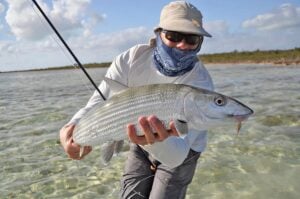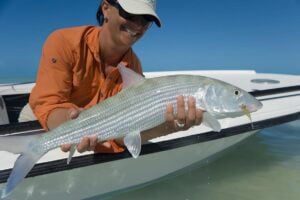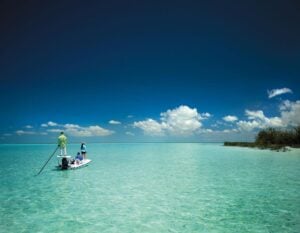
Most anglers who try bonefishing in the Bahamas once find themselves planning a return. The combination of vast, productive flats, guides whose knowledge of this specific water runs generations deep, and a species that genuinely rewards preparation makes it unlike most saltwater fishing. Understanding what you’re getting into — the technique, the tides, the gear — is the most useful thing you can do before the trip.
Fishing for bonefish requires spotting the fish before you cast — reading its speed and direction, placing the fly ahead of it, and stripping. That sequence sounds straightforward. On the flats it rarely is. The fish are fast, acutely aware of movement and shadow, and gone the moment something feels wrong. The Bahamas offers the best environment in the world to develop that skill: more fishable flats than anywhere else in the Caribbean, a guiding culture built over generations on this specific water, and a season that runs October through June across Andros, Abaco, and beyond.
For a more in-depth look at the Bahamas fishery and how to choose between islands — including a detailed breakdown of Andros versus Abaco — see our guide to bonefishing in the Bahamas.
What Bonefish Are — and Why They Fish the Way They Do
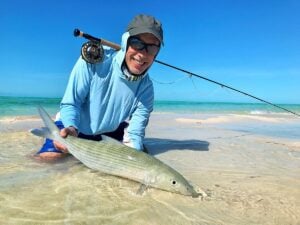
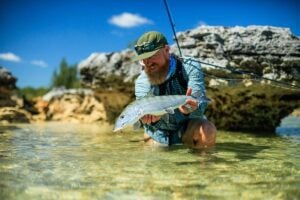
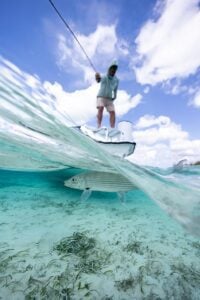
Bonefish (Albula vulpes) are a flats species — shallow-water fish built for speed and equipped with eyesight sharp enough to detect a poorly placed fly, a heavy footstep on the bottom, or the shadow of a rod moving overhead. They feed head-down on shrimp, crabs, and small baitfish in inches of water, which is what puts them within reach of the fly rod. Their mirrored, silver-blue flanks make them nearly invisible against sand and turtle grass in bright tropical light — the reason guides spend years learning to read water rather than simply scan for fish.
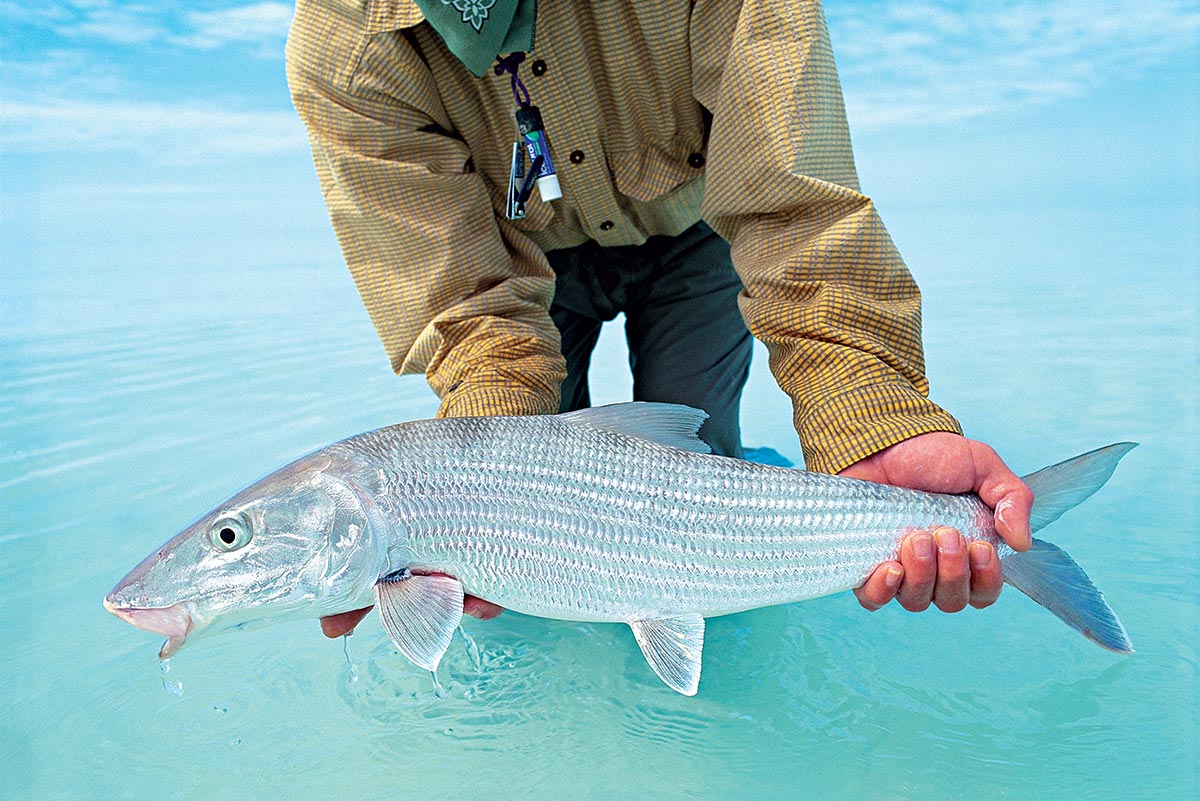
On the take, a bonefish runs. Fast and far — typically 100 yards or more on the first run, deep into the backing. That speed, combined with the visual demands of presenting a fly to a moving fish in clear, shallow water, is what makes bonefishing one of the more technically engaging forms of saltwater fishing available.
For a full breakdown of the species across its global range, see our bonefishing page.
Where to Find Bonefish on the Flats
Knowing where bonefish lie on a given tide is what separates a guide from a tourist with a rod. When you start fishing for bonefish, you quickly learn that fish don’t distribute randomly across the flat — they move on a predictable schedule, and understanding that schedule is the first practical skill in bonefishing.
Reading the Tide
The tide drives everything. On an incoming tide, bonefish push up onto the flats to feed — this is typically the most active and productive window, when fish are moving with purpose and willing to eat. As the tide falls, they retreat toward channel edges, creek mouths, and deeper water; fewer fish are reachable on foot or from a skiff, but larger singles and pairs often hold on the drop-off edges and will take a well-presented fly. At slack tide the window narrows — fish become harder to read and more cautious, and presentation needs to be precise. Guides build the entire day around this cycle, positioning anglers ahead of where the fish will be rather than where they are.
What to Look For
Most first-time flats anglers spend the first morning seeing nothing. The fish are there — the guide can see them — but the untrained eye reads every ripple as a tail and every dark patch as a fish. The adjustment takes time, and polarised glasses are not optional: without amber or copper lenses cutting the surface glare, most of what makes a bonefish visible simply isn’t.
What you are actually looking for:
- Tailing fish — the clearest signal. A bonefish feeding head-down tips its tail above the surface. On a calm flat it’s unmistakable; in a chop it disappears quickly.
- Nervous water — surface disturbance that doesn’t match the wind direction or speed. A school of bonefish moving through shallow water pushes a subtle wake that experienced eyes read immediately.
- Shadows and flashes — on bright sandy bottom, a moving fish throws a shadow and occasionally catches the sun on its flank. These are brief and easy to miss.
- Cruising fish — moving with purpose, usually in pairs or small groups, tracking a feeding line across the flat. Less dramatic than tailers but often larger.
Habitat and Bottom Type
Not all flats fish the same way, and the bottom beneath the water tells you a great deal about what to expect.
Hard white sand — the kind found on Abaco’s ocean flats and South Andros’s southern cay systems — is ideal for wading. Fish are highly visible against the bright bottom but correspondingly more wary; the clear water and firm ground mean they can see you as clearly as you can see them. Presentations need to be precise and leaders need to land quietly.
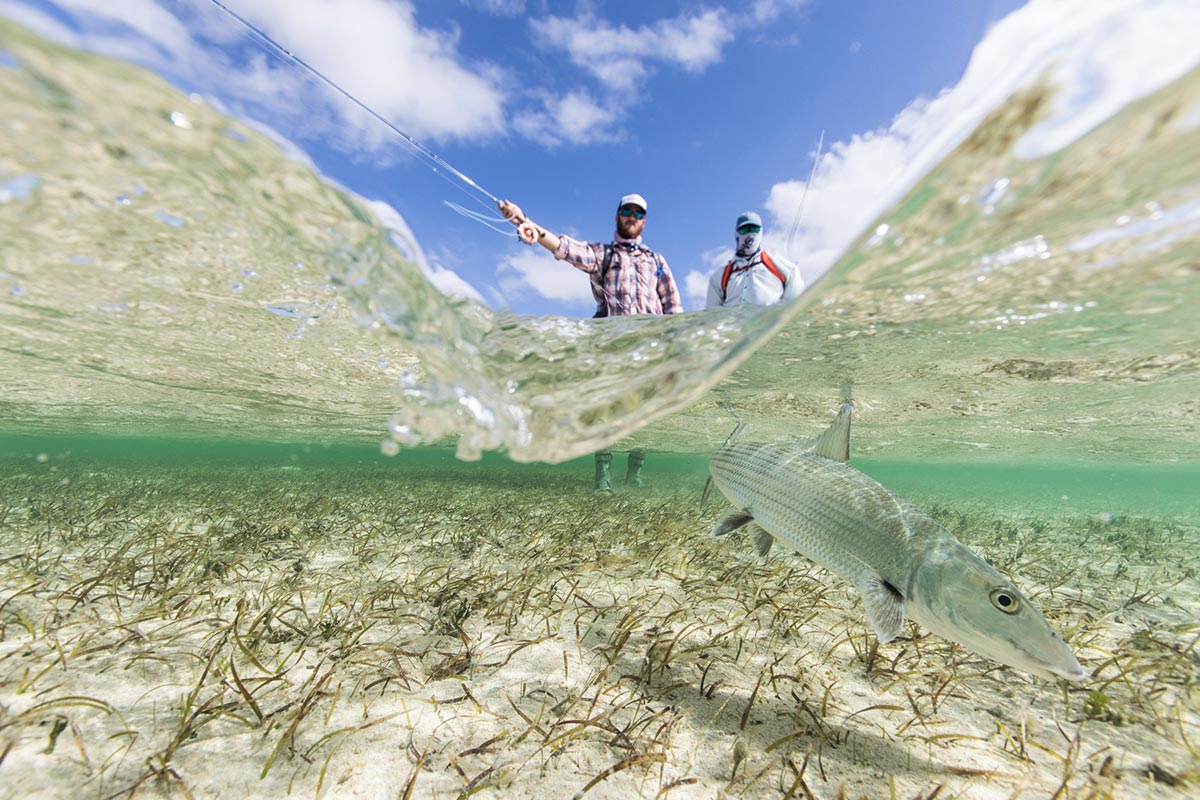
Soft marl and turtle grass — the Marls on Abaco’s west side, the Bights of Andros — suits skiff-based fishing. The bottom is too soft for wading across most of it, but fish are less pressured and tailing schools are a common sight. The guide poles the skiff across the flat and positions anglers for shots at fish that are often less suspicious than their hard-sand counterparts.
Mangrove edges and creek mouths concentrate fish during tidal transitions — as water moves on and off the flat, bonefish stack at the entry and exit points. These areas are particularly productive on a falling tide and offer sheltered fishing when wind makes the open flat difficult.
How to Catch Bonefish — Technique on the Flats
Bonefish fly fishing in the Bahamas is built entirely around sight — you see the fish before you cast, and everything that follows depends on executing a short sequence correctly under pressure. The bonefishing techniques that matter most come down to three things: the cast, the retrieve, and reading the fish. Knowing how to bonefish effectively means having all three working together — and anglers who arrive having practiced consistently do measurably better than those who haven’t, regardless of experience in other forms of fishing.
The Cast
Distance is less important than accuracy. Most shots on the Bahamian flats are between 30 and 50 feet — well within the range of any competent caster — but they need to land precisely, quickly, and quietly. A fly that lands three feet too close spooks the fish. One that lands two feet too far gets ignored. The leader needs to turn over cleanly and the fly needs to enter the water without a hard splash.
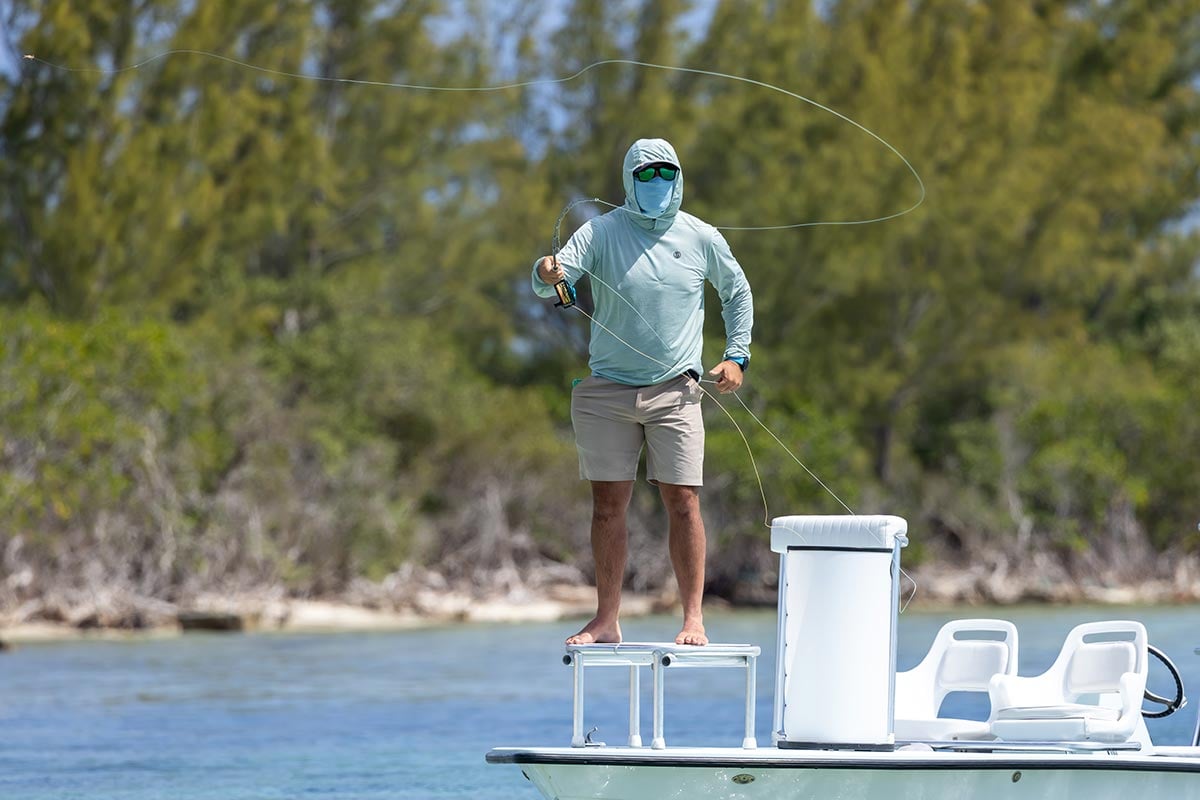
False casting is the enemy of a good shot. Every false cast costs time, risks spooking the fish, and signals to the guide that the angler isn’t ready. On the flats, the standard is one backcast and one forward delivery. That requires line speed — which is where the double haul becomes essential.

The double haul is not an advanced technique reserved for experienced casters. It is the baseline for fishing in Bahamas conditions, where trade winds are a near-constant variable and the ability to drive a fly accurately into a crosswind separates productive days from difficult ones. What it does is load the rod faster and generate more line speed than a standard cast, allowing accurate delivery with minimal false casting.
The mechanics:
- Begin the backcast and simultaneously pull down on the fly line with your stripping hand — this is the first haul
- As the loop unrolls behind you, let the stripping hand drift back up toward the rod
- Drive into the forward cast and pull down hard again with the stripping hand — the second haul
- Release line into the cast as the rod unloads
Practice this until it requires no conscious thought. On the flats, when the guide says “ten o’clock, 40 feet, moving left,” there is no time to think about casting mechanics. The haul needs to be reflex, not technique.
The Retrieve
Once the fly is in the water and the fish is within range, the retrieve becomes the conversation. Strip too fast and the fly outruns what a shrimp or crab can realistically do. Strip too slowly and the fish loses interest. The standard is short, smooth strips — pulling the fly in a way that mimics a crustacean making a deliberate but unhurried escape.
Watch the fish throughout. If it tips its nose down or accelerates toward the fly, it is committed — continue stripping at the same rhythm and do not change anything. If it loses interest and veers away, a pause sometimes triggers a second look. What almost never works is speeding up in panic when the fish seems to be losing interest.
The strip-set is the single most important habit to build before arriving. When a bonefish takes, the instinct is to lift the rod — the same motion that sets a hook in most other forms of fishing. On the flats it pulls the fly directly out of the fish’s mouth. The correct response is to strip firm and downward with the line hand while keeping the rod low. The hook sets into the corner of the mouth and the fish runs. Then the rod comes up.
The Fight and Release
Bonefish run fast and far — a fish of 4 lbs will peel 80 yards of line on the first run without slowing. Once the fish is running, keep the rod low and apply side pressure rather than lifting — a high rod gives the fish leverage and increases the chance of throwing the hook. Let the fish run against the drag and bring it back steadily once it stops. Do not rush the landing; a fish brought in too quickly is exhausted and recovers poorly.
For release, wet your hands before touching the fish, keep it in the water throughout, and hold it facing into the current until it kicks free on its own. Catch and release is the norm across all Bahamas lodge programs — both because the fishery depends on it and because Bahamian regulations strongly encourage it. A bonefish handled correctly and released quickly will be on the flat again within minutes.
Gear for Bonefishing in the Bahamas
The gear requirements for Bahamas bonefishing are straightforward. The list is short — but each item on it matters, and arriving with the wrong setup on a windy day on the flats is a problem that no amount of guiding can fix.
| Category | Recommendation |
|---|---|
| Rod | 8- or 9-weight saltwater fly rod for standard conditions — the Bahamas is windy and an 8-weight is the practical minimum for accurate distance casting in a crosswind. On calmer days and sheltered water, a 7-weight gives a quieter presentation and spooks fewer fish in skinny water. Bring two outfits if possible. |
| Reel | Large arbor, sealed drag. Minimum 150–200 yards of 20 lb backing — bonefish run far on the first run and the backing gets used. |
| Line | Weight-forward floating tropical line. Standard freshwater coatings go limp in heat and stick in the guides — a saltwater-rated tropical line is not optional. |
| Leader | 9–12 ft fluorocarbon, tapering to 10–12 lb tippet. Longer leaders give the fly more time to sink naturally and reduce the chance of the line landing on the fish. |
| Flies | Gotcha, Crazy Charlie, Spawning Shrimp, Bonefish Bitters — in tan, pink, and olive. Weight to match water depth: bead chain eyes for skinny water, dumbbell eyes for deeper flats or wind. Most lodge guides carry local variations and will advise on the day. |
| Polarised glasses | Amber or copper lenses. Non-negotiable — without them, spotting fish on the flats is close to impossible. |
| Sun protection | Full-length shirt, buff, hat. A full day on the flats in tropical sun is serious exposure. |
| Flats boots | Essential for wading on hard-sand flats — coral and sea urchins are a reality on the ocean-side fisheries. |
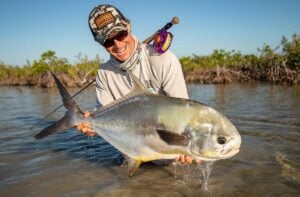
If tarpon or permit fishing are any part of the program, a 10-weight rigged and ready is worth having as a second outfit.
For anglers who prefer spinning gear, light-action rods with small jigs on fluorocarbon leaders can be effective in some conditions — but the fly rod is the standard across all Bahamas lodge programs and the clear choice for flats fishing.
Best Bonefishing in the Bahamas — Where to Fish
For visiting anglers wondering where to catch bonefish, the Bahamas delivers some of the best bonefishing in the world — more fishable flats acreage, more experienced guides, and more lodge programs built specifically around the pursuit than any comparable destination. The best bonefishing in the Bahamas is concentrated on two islands, but the chain offers productive water well beyond them.
For a direct comparison of lodge programs across the island chain, see our Editorial Guide to Bahamas Fishing Lodge Programs.
Andros
Andros is the largest island in the Bahamas and the one most serious bonefishing anglers end up on. The Bights — the sprawling network of tidal flats, mangrove creeks, and channels running through the centre of the island — hold fish in numbers rarely matched elsewhere, and the opposing tidal system on the east and west sides means guides based at central Andros can almost always find productive water regardless of wind direction. Fish across the Bights average 3–5 lbs with consistent encounters in the 6–8 lb range.
The West Side of Andros — known among serious anglers as the Land of the Giants — is a different proposition. Remote, lightly pressured, and producing double-digit bonefish on a regular seasonal basis, it is the most consistently productive trophy bonefish water in the Bahamas. South Andros adds further dimension: hard white-sand flats extending toward the Water Cays and Curley Cut Cays that consistently produce fish in the 7–10 lb class.
For a detailed look at the Andros fishery, see our Andros island bonefishing guide.
Abaco
Abaco is the most accessible bonefishing destination in the Bahamas for US East Coast anglers — direct commercial flights from Miami, Fort Lauderdale, and Atlanta reach Marsh Harbour without a Nassau connection. The Marls on the west side of Great Abaco Island offer 300 square miles of sheltered, mangrove-edged flats where tailing schools are a daily sight and fish average 2–4 lbs in consistent numbers. The ocean-side flats — particularly Cherokee Sound — hold fewer fish but considerably larger ones, averaging 3–5 lbs with trophy fish to 12 lbs on hard white sand ideal for wading.
Abaco also offers the most consistent permit fishing in the island chain, with the southern flats around Sandy Point, Mores Island, and Gorda Cay holding permit in numbers unusual for the Bahamas. For anglers with permit as a serious target rather than an incidental bonus, Abaco’s southern flats are the clearest answer the islands offer.
For a detailed look at the Abaco fishery, see our Abaco bonefishing guide.
Beyond Andros and Abaco
The best bonefishing bahamas has to offer sits on Andros and Abaco, but the island chain holds productive water beyond those two destinations. Bonefishing in Exuma offers clear, sandy flats with consistent fish and lower pressure than the more developed islands — a strong option for anglers combining bonefishing with broader Bahamas travel. Bonefishing Grand Bahama Island is accessible directly from Florida, with productive flats near Freeport and the East End making it one of the more logistically straightforward options in the chain. Long Island and Bimini both hold fish on less-pressured water, with Bimini adding quick access from South Florida for those on a shorter trip.
For more on fishing across the Bahamas island chain, see our Bahamas regional page.
Bahamas Fishing License — What Anglers Need to Know
A Bahamas fishing license is required for all non-Bahamian anglers over the age of 12 fishing bonefish, tarpon, permit, or cobia on the flats — regardless of whether you are wading independently or fishing from a guide’s skiff. The regulations introduced in 2017 formalised what was previously an informal system, and enforcement has tightened steadily since.
For lodge-based anglers, this is straightforward in practice. Lodge operators are permitted to arrange and pay for licences on behalf of guests before arrival, and most Bahamas lodge programs handle this as part of the arrival process. Confirm with your lodge when booking — you should not need to source a licence independently.
The current Personal Angler Licence fee structure for non-Bahamian visitors is as follows:
| Duration | Fee |
|---|---|
| Day (valid date of issue only) | $15 |
| Weekly | $50 |
| Monthly | $100 |
| Annual | $600 |
Fees are subject to change. Always verify current figures with the Bahamas Department of Marine Resources before travel.
A few further regulations worth knowing before fishing the flats:
- Guided requirement: Two or more anglers fishing the flats from a vessel must use a licensed Bahamian guide. Solo anglers wading independently do not require a guide, but one is strongly recommended — the fishing improves significantly with local knowledge.
- Vessels: Only Bahamian-registered vessels are permitted on the flats. Lodge guests fishing from a guide’s skiff are automatically compliant.
- Catch and release: There is no bag limit for bonefish, but catch and release is strongly encouraged and the norm across all Bahamas lodge programs. The flats fishery depends on it.
- Legal methods: Hook and line only. No nets, traps, or spearfishing on the flats.
Best Time to Go Bonefishing in the Bahamas
The Bahamas bonefishing season runs October through June, with most lodge programs closing in August and September during peak hurricane risk. Within that window, the fishing changes character significantly depending on when you go.
October and November are more productive than their reputation suggests — fish are fresh back on the flats in numbers after the summer, guiding pressure is well below the spring peak, and the Abaco Marls hold large pre-spawning bonefish aggregations through October that are among the most spectacular sights in Caribbean bonefishing.
December through February is the trophy window. Cooler water concentrates larger fish on the flats during warm tidal pushes, and the West Side of Andros and Cherokee Sound on Abaco produce their most consistent shots at double-digit fish through this period. Trade winds run consistently — anglers should expect wind and be comfortable casting in it.
March through May is peak season — stable weather, active fish across both islands, and the permit window opening from late April. Prime weeks at the best-known lodges book a year or more in advance. June and July bring the tarpon peak on both Andros and Abaco alongside continued strong bonefishing, with calmer winds giving guides more flexibility across the full range of each island’s water.
For a detailed month-by-month breakdown of bonefish, tarpon, and permit windows across both islands, see our Bahamas bonefishing season guide.