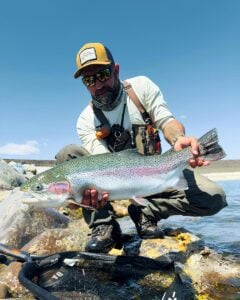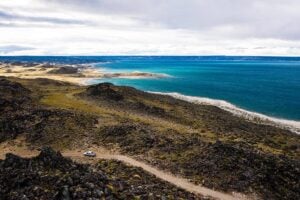
Few places on earth have the hold on a trout angler’s imagination that Patagonia does. Wild rivers, fish that have been thriving in cold Andean water for over a century, and landscapes that most anglers only ever see in photographs. The reputation is deserved.
Argentina’s notoriety as a trout fishing hub was built on Patagonia — wild rivers running cold out of the Andes, estancias with access to water that most visiting anglers never reach, and fish that have been reproducing without meaningful human interference since the early twentieth century. That stature is well earned. But “Patagonia trout fishing” as a phrase papers over a range of experiences stretching from working a midge hatch on the Malleo’s spring creek waters to swinging a fourteen-foot Spey rod into a Fuegian gale.
Understanding what separates those experiences is what this guide is built around. The northern lake district, the remote backcountry of Chubut, the trophy stillwater of the Strobel Plateau, and the sea-run rivers of the far south — each a completely different pursuit demanding a different mindset, each warranting a separate trip.

Northern Patagonia Trout Fishing
The Andean Lake District
Northern Patagonia is the most visited fly fishing region in Argentina, and for good reason — it holds a concentration of water types within a few hours’ drive that is broader than almost any other trout fishing destination in the world. Spanning Neuquén and Río Negro provinces, it is where Argentina’s fly fishing culture took root.
The landscape divides sharply along the Andean spine: to the west, dense temperate Andean forest, glacial lakes, and volcanic terrain where lake systems feed and regulate the region’s rivers, giving them a more stable and consistent character than purely snowmelt-driven freestone systems. Moving east, the rain shadow takes hold — the forest thins, the terrain opens, and the rivers flow out across an increasingly arid, wind-scoured plain that feels closer to the American West than the lush Andean valleys upstream.
A well-designed week here will typically cover several different waters — a day on a drift river, a morning on a spring creek, an afternoon at a lake outlet. That variety is the point, and what follows covers the main river and lake types rather than exhaustive detail on any single fishery.
The Classic Rivers of Northern Patagonia
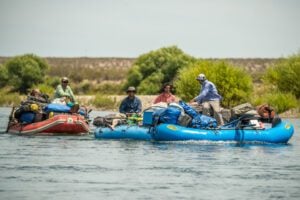
The Chimehuín, Aluminé, and Collón Curá are the iconic rivers of Neuquén province, centered around Junín de los Andes — wide, boulder-strewn systems that you fish from a drift boat or raft, covering miles of runs across long Patagonian summer days. The scale can surprise first-time visitors. These are not intimate wading rivers; they are muscular freestone systems running cold from snowmelt and Andean lake outflows, with the kind of open sky above them that makes an angler feel very small.
Browns dominate the larger systems; rainbows are found throughout and are more willing surface feeders through the summer months. Terrestrial insects — hoppers, beetles, ants — are a constant through the season, alongside more dramatic events like the willow worm hatch and minnow run that bring fish to the surface in numbers. Fish in the 2 to 4-pound range are typical, with 6-pound fish not uncommon on the better beats.
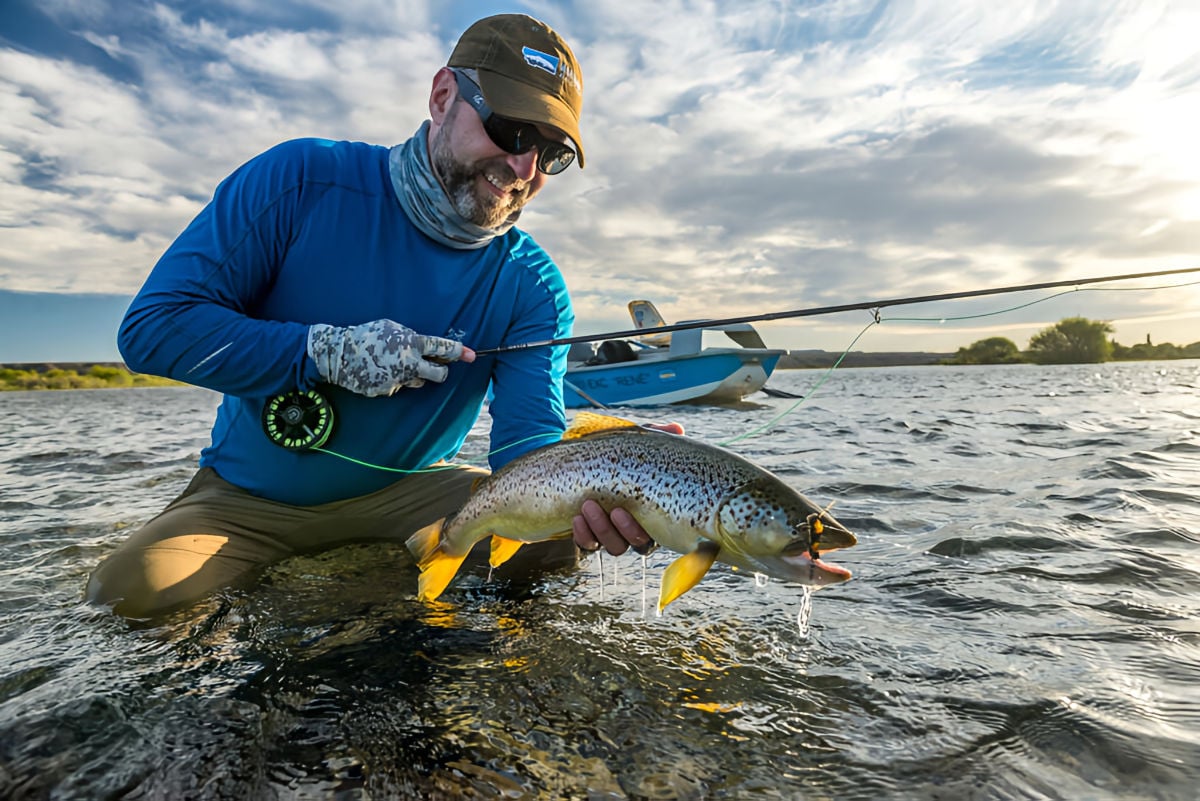
The Limay and Río Traful each offer something the classic drift rivers don’t.
The Limay flows from Lake Nahuel Huapi, and from end of March through the close of the season in mid-April, large migratory browns move out of the lake ahead of their autumn spawning run, feeding aggressively on pancora crabs (a native freshwater crustacean) and the minnows that concentrate during the late-season run. The best fishing is on the middle section — Limay Medio — well away from the crowded stretches near Bariloche. Chrome-bright fish fresh from the lake, running to 30 inches and beyond, in a river that fishes nothing like the technical spring creek water the region is better known for.
The Río Traful is a shorter, quieter river flowing cold and clear between two lake systems in Neuquén province, fished exclusively by wading. New Zealand-style sight fishing is the norm here: spotting fish, planning the approach, and presenting precisely to a specific trout in gin-clear water. It consistently produces some of the largest resident browns and rainbows in northern Patagonia, and it is one of the few rivers in Argentina with a population of landlocked Atlantic salmon — an unpredictable but extraordinary bycatch for anglers prepared for the unexpected. It is however not a numbers fishery. Days when everything clicks produce fish of a lifetime; days when it doesn’t can be humbling.
The Malleo – Technical Dry Fly Fishing
Northern Patagonia has no shortage of dry fly water, but no river defines the region’s reputation for technical dry fly fishing quite like the Malleo. Running through Lanín National Park in the shadow of Volcán Lanín and fed by the cold outflows of Lago Tromen, it moves slowly through open meadow sections — clear and shallow, with fish visible in the current and delicate presentations a requirement
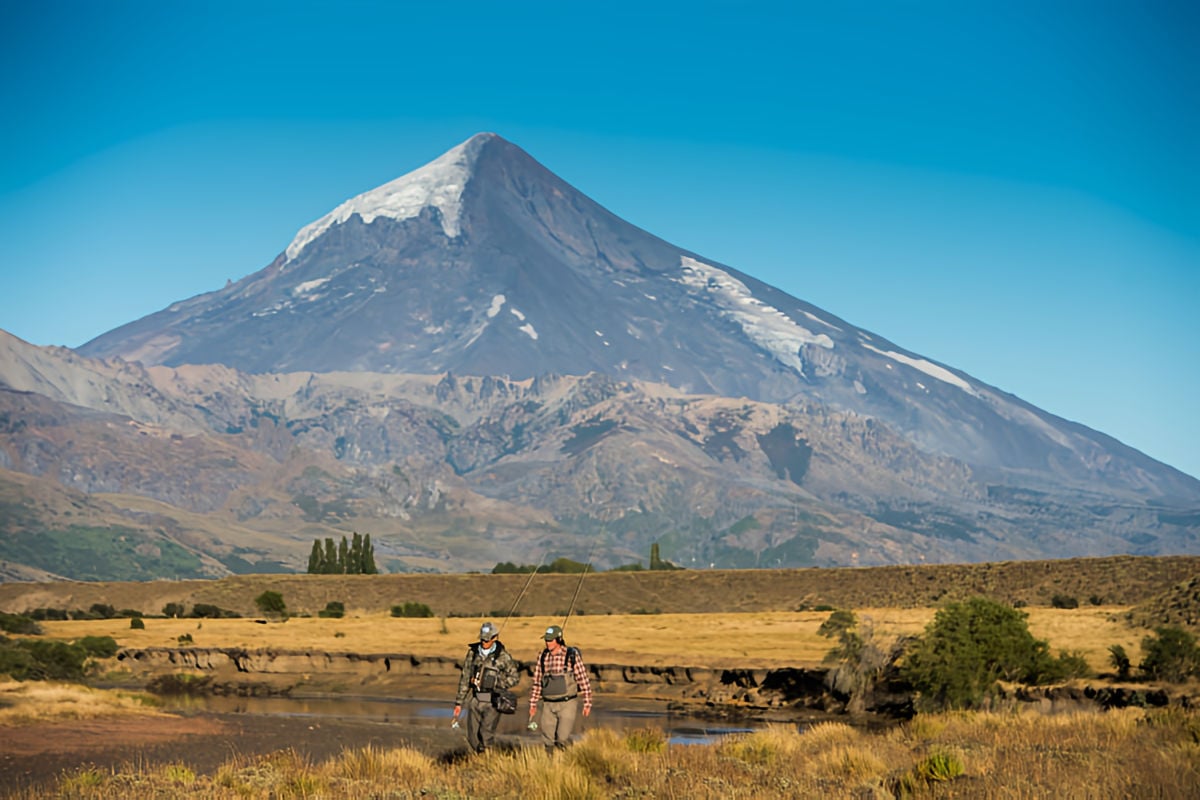
Through January and February, prolific caddis and mayfly hatches bring fish to the surface, and the river rewards the angler who can read a rise, match what’s on the water, and deliver a fly precisely to a fish that has already seen everything.
Andean Lakes – Stillwater & Outlet Fishing
The lakes of northern Patagonia are not just beautiful scenery — they are a fishable part of most well-designed fishing programs, and for the rivers that flow from them they provide a more stable, regulated character than purely snowmelt-driven systems.
Where a large glacial lake empties into a river system, trout congregate to feed on the concentrated food supply that lake outflows produce — often in water shallow enough for precise dry fly or nymph presentations. The Chimehuín’s outlet from Lago Huechulafquen, near Junín de los Andes, is the most recognizable example, drawing fish and anglers to a defined zone that guides return to across the season.
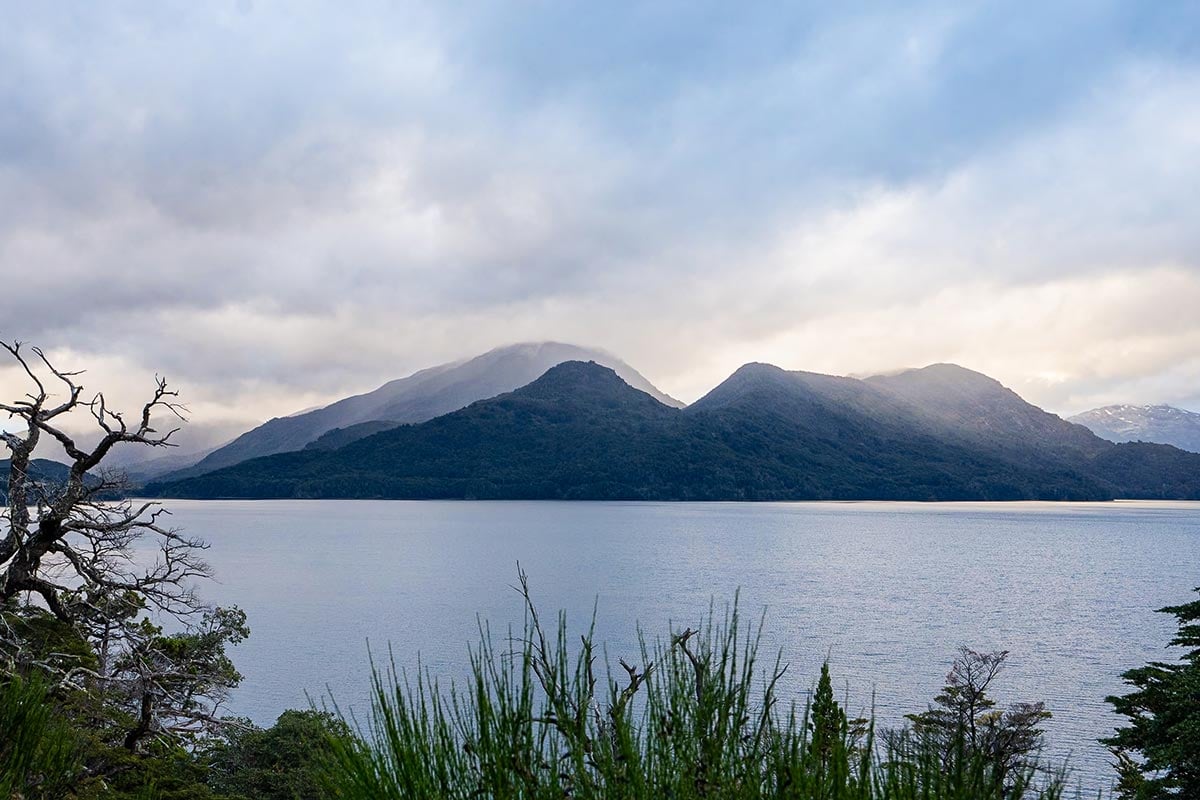
Lodge programs with full lake access add a further dimension to any trip — working lake margins in early season when rivers are still transitional, fishing drop-offs and wind lanes for large resident browns and rainbows, or targeting inflowing river mouths where fish gather ahead of their upstream migration. For anglers whose week coincides with early November or late April, when river conditions are least predictable, lake fishing can be the variable that saves the trip rather than supplements it.
Why Fish Northern Patagonia: The northern lake district offers the broadest introduction to Patagonia trout fishing — more water types, more lodge options, and the best dry fly fishing in the country, driven by exceptional insect life and prolific seasonal hatches. For a first visit, or for any angler who wants to fish several different styles of water in a single week, it remains the natural starting point.
Northern Patagonia Season: November through April — peak dry fly conditions in January and February, with March and April the preferred window for large browns. For the full seasonal breakdown, see our when to fly fish in Patagonia Argentina guide.
Northern Patagonia Species: Brown trout dominate larger systems. Rainbow trout throughout rivers and lake systems. Brook trout in smaller, higher-elevation spring creeks and alpine lakes. Landlocked Atlantic salmon in the Río Traful.
Central Patagonia Trout Fishing
Chubut’s Remote Backcountry
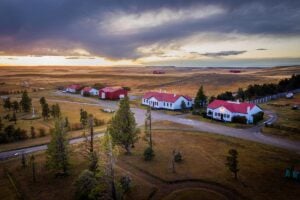
Occupying a vast swathe of Patagonia, the central region stretches from the forested Andean cordillera around Esquel and Trevelin down through the Río Pico area to the Santa Cruz border. It holds some of the most rewarding wild trout fishing in Argentina — and almost no international profile to show for it. As a result, central Patagonia receives a fraction of the visiting rods that the northern lake district does. So much so that in the more remote corners of Chubut province, some waters see virtually no angler tourism in an entire season.
The rivers here — predominantly snowmelt-fed freestone systems rather than the lake-moderated flows of the north — respond more directly to seasonal conditions, and fish with a character that reflects it.
Río Pico & Corcovado
The Río Pico system is the headline act — an immense network of interconnected lakes and Andean drainages that guides and outfitters quietly describe as the best big-trout country in all of Patagonia. Unlike the classic drift rivers of the north, this is predominantly walk-and-wade water: wild browns and rainbows fished on foot through remote Andean valleys, on rivers that may see only a handful of visiting rods. The numbered lakes, the Río Pico herself and her tributaries, and the Río Corcovado all sit within this reach of southern Chubut. The dozen-plus Río Pico lakes — with legitimate shots at fish of up to 20 pounds — represent some of the finest stillwater trout fishing in Patagonia, and are as much a reason to visit as the rivers.
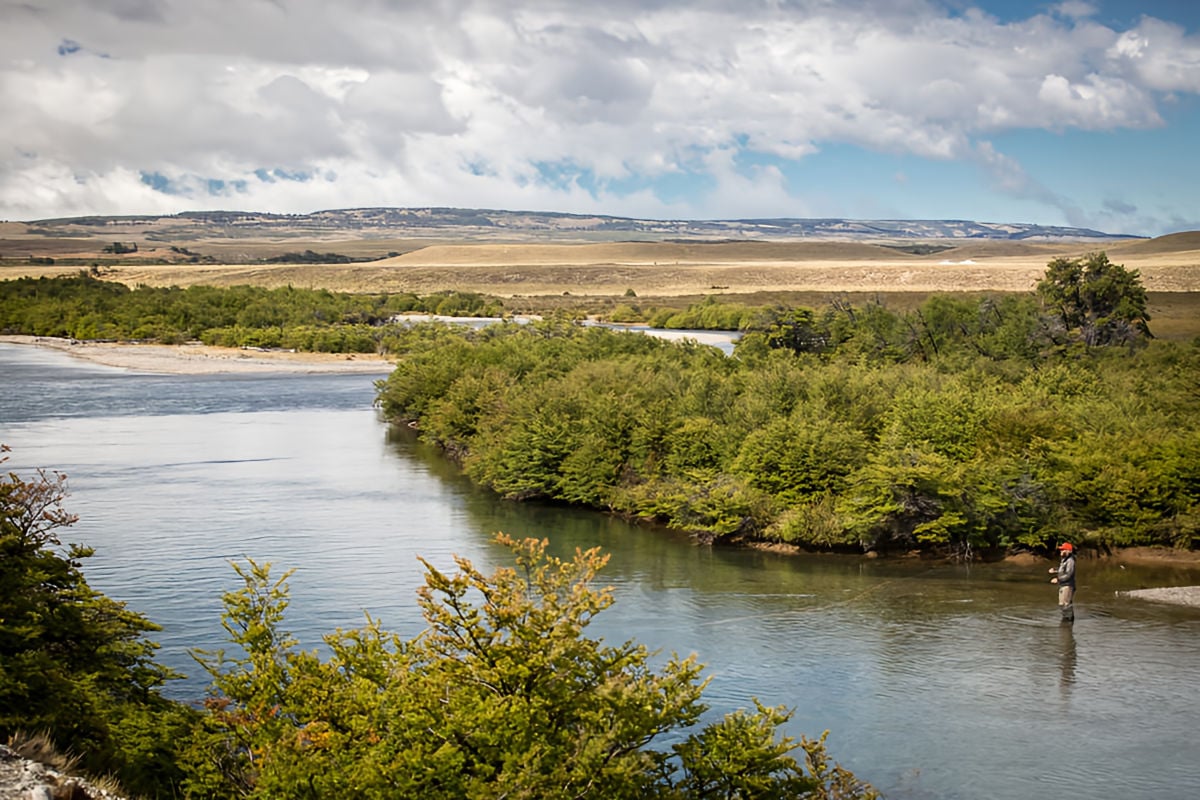
The Corcovado originates at Lago Vintter — a glacial lake nearly a thousand feet deep that straddles the Argentine-Chilean border — and stretches more than sixty miles through fast-flowing whitewater and classic pool-riffle water before crossing into Chile. It holds large, powerful brown trout, rainbows, and one of the most significant brook trout fisheries in the southern hemisphere, with fish that rival the trophy brook trout of Labrador, Canada. Chinook salmon — escapees from Chilean Pacific fish farms that have established themselves in the river system — also run the Corcovado, making it one of the few rivers in Argentina where an angler might encounter four species in a single day.
Esquel & Trevelin
Away from the remote backcountry that defines central Patagonia, the Esquel and Trevelin area is easily reached by direct flight from Buenos Aires and offers more fishing variety within a short drive than most destinations manage in a full week.
The Arroyo Pescado — a spring creek cutting through open Patagonian steppe thirty minutes east of Esquel — is widely regarded as one of the finest spring creeks in the world: the same technical demands as the Malleo, in a completely different landscape.
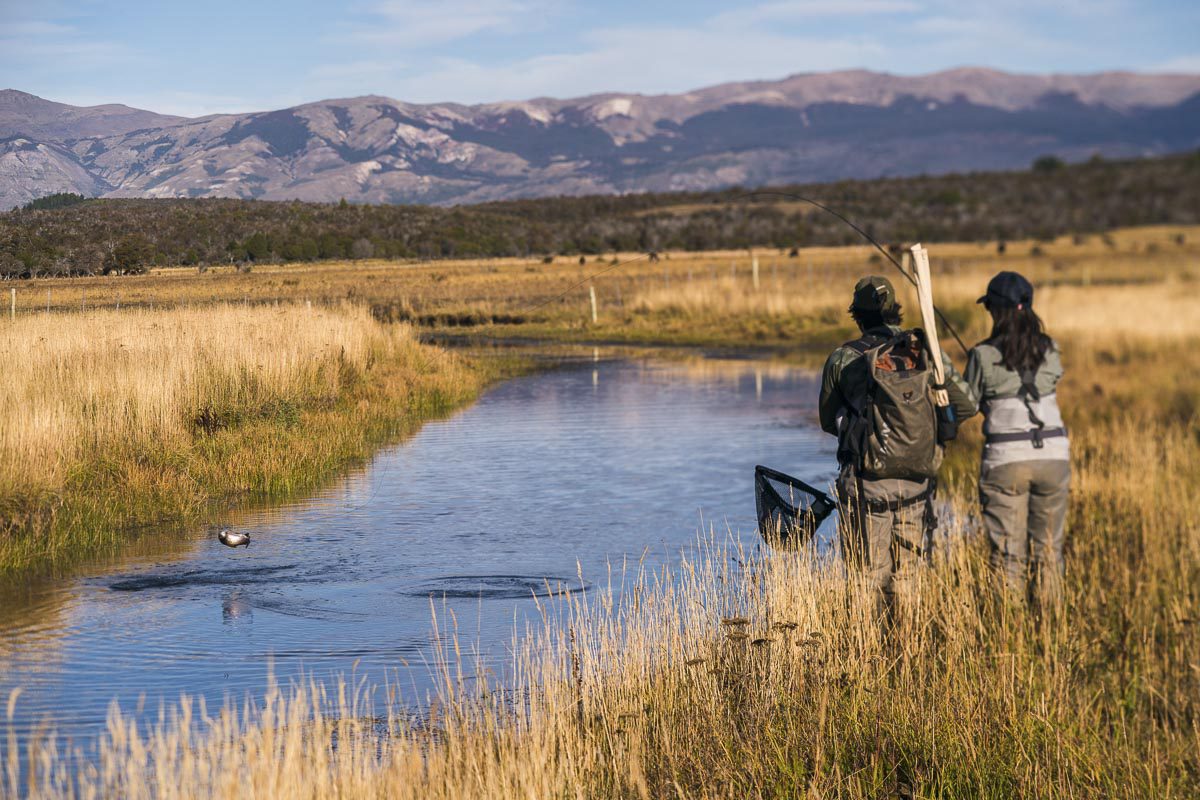
For those drawn to the backcountry float experience, the Río Chubut covers sixty kilometres of private estancia water accessible only by spending three to four days drifting and camping — with eager, surface-hungry browns and rainbows that make up in willingness what the Corcovado fish offer in size.
Los Alerces National Park
Los Alerces National Park, in the Andean foothills west of Esquel, anchors the lake fishing in central Patagonia — a UNESCO World Heritage landscape of dense ancient forest and glacial lakes in intense shades of blue and green, as different from the open steppe as Patagonia gets. Covering more than 640,000 acres of temperate Andean forest and interconnected lake and river systems, it is one of the most significant protected trout fisheries in South America. Only its eastern edge is accessible by road and many of its best waters reachable only by boat or with a guide who knows the system.
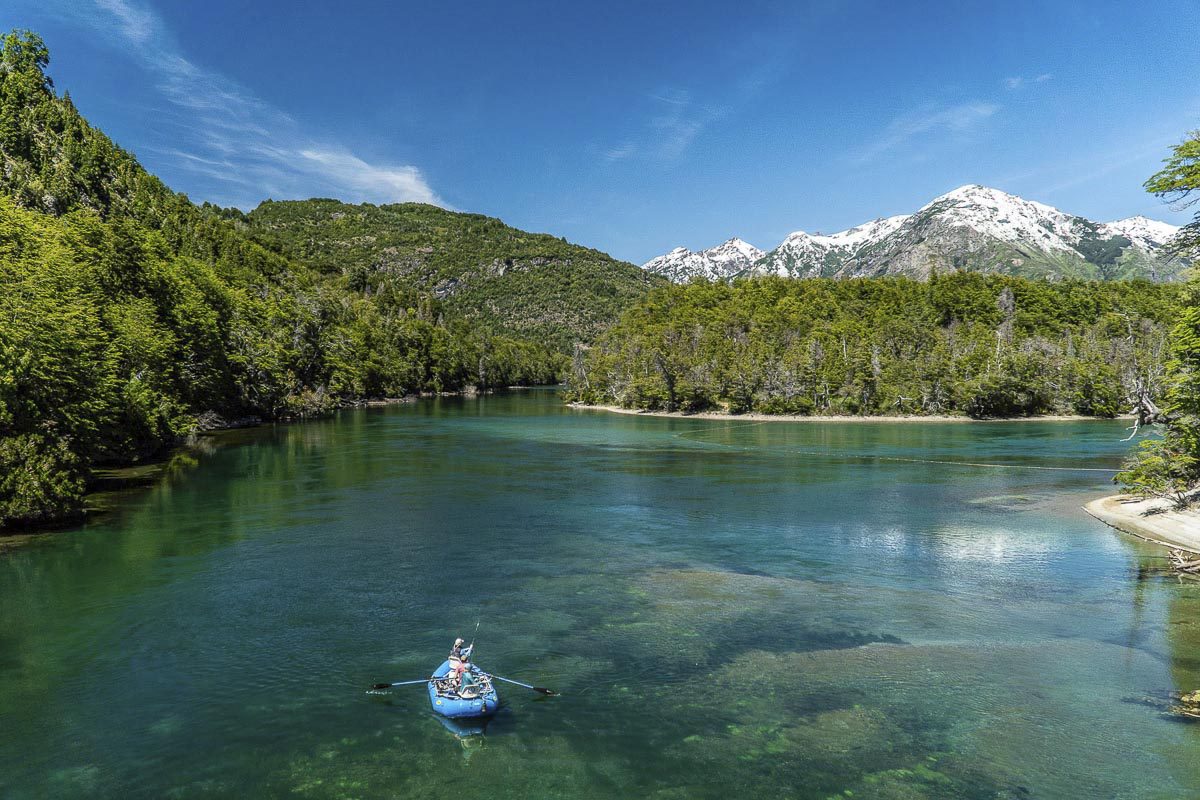
Lake Futalaufquen and the connected lake system hold large resident browns and rainbows, with lake outlet fishing at the park’s river connections among the most productive in central Patagonia. The park’s regulated waters also include the Río Rivadavia — one of the most celebrated trout rivers in Los Alerces —extraordinarily clear, with resident browns and rainbows that fight with power that belies the delicacy required to catch them.
Why Fish Central Patagonia: The best waters here rival the northern rivers for fish size and the region covers two very different propositions — the accessible, diverse fishing around Esquel and Trevelin, and the remote big-trout wilderness of the Río Pico area. Both offer something the established northern circuits don’t: significantly fewer rods on the water and a genuine sense of fishing somewhere most visiting anglers never reach.
Central Patagonia Season: November through April, broadly matching the same seasonal arc as northern Patagonia.
Central Patagonia Species: Wild brown trout and rainbow trout throughout. Brook trout prominent in the Río Pico and Corcovado systems — among the largest in the southern hemisphere. Chinook salmon established in the Río Corcovado.
Southern Patagonia Trout Fishing
Santa Cruz & Tierra del Fuego
Southern Patagonia holds two of the most specialist fishing pursuits in Argentina, and neither resembles anything in the north. The first is Jurassic Lake, a remote trophy stillwater fishery for giant rainbow trout on the windswept Strobel Plateau. The second is sea-run brown trout, pursued on two rivers of very different character: the Río Gallegos in Santa Cruz, and the Río Grande in Tierra del Fuego — the world’s most celebrated sea-run brown trout river.
Unlike northern and central Patagonia where a week typically spans multiple rivers and water types, each of these fisheries is built around a single-minded commitment to essentially one water, one species and one method.
Jurassic Lake, Santa Cruz – Trophy Rainbow Trout
Lago Strobel sits on a remote plateau in Santa Cruz province, known internationally as Jurassic Lake. It entered the fly fishing world in the early 2000s when Swedish fly fishing pioneer Christer Sjöberg, co-founder of Loop Tackle, led an expedition to the lake and found rainbow trout of a size that strained credibility. There are only a handful of lodge programs with lake access — the most popular weeks book well in advance.

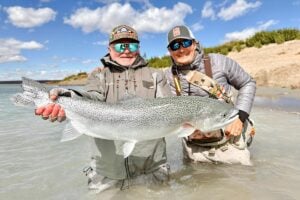
The reasons for the fish size are straightforward. Lago Strobel is an endorheic basin — approximately 65 square kilometers with no natural outlet — which means nutrients accumulate rather than drain away. No natural predators, exceptionally dense scud (freshwater shrimp) populations, and biannual spawning migrations up the Barrancoso River — the lake’s only tributary — create an environment where rainbows grow rapidly and live long. Fish averaging 6 to 8 pounds; double-figure fish are routine, and specimens over 20 pounds are taken every week of the season.
There are no drift boats, no hatches to read, no spring creeks. Anglers fish entirely on foot along exposed plateau shoreline — casting into sustained Patagonian wind on an 8-weight minimum, stripping back through clear water, watching for follows and takes that define stillwater hunting. A moderate wind is no obstacle — it concentrates food along the shoreline and pushes fish into defined bays where sight fishing can be exceptional. Programs with access to the Barrancoso River add a further dimension — early and late in the season it holds fish concentrations that can be extraordinary.
Anglers who fish as much for the landscape as the quarry will find it uncompromising. Those motivated by a realistic prospect of a wild rainbow over 15 pounds on a fly rod will find nothing comparable.
Río Grande, Tierra del Fuego – Sea-Run Brown Trout
Tierra del Fuego sits across the Straits of Magellan from the Patagonian mainland — a windswept, treeless archipelago at the southern tip of South America. The Río Grande rises on the open plain of Tierra del Fuego and runs east to the South Atlantic. It fishes like a structured Atlantic salmon river — wide, wind-exposed, managed through a private beat rotation, with anglers swinging flies for fish that have fed in the ocean before returning to freshwater.
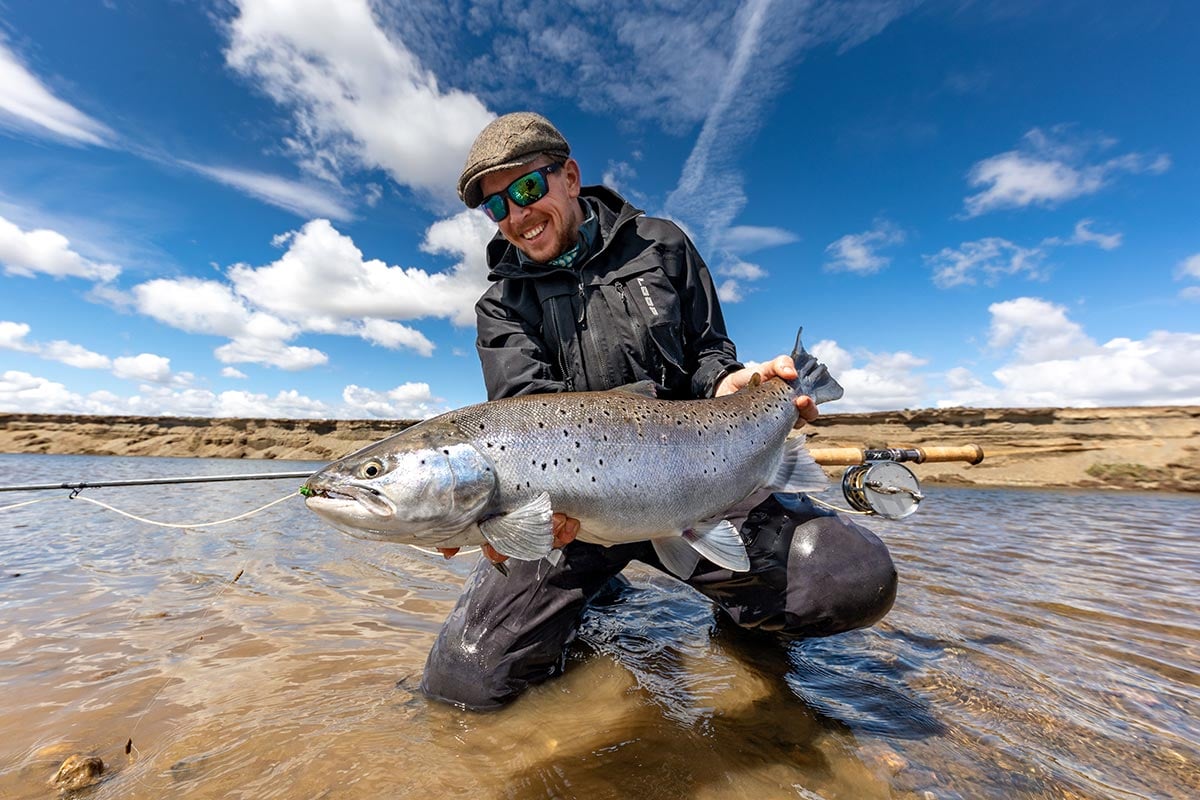
The sea-run brown trout average 8 to 12 pounds on the Río Grande, with fish over 20 pounds taken regularly and records exceeding 30 pounds. More IGFA world records have been set here than on any other sea-run brown trout river.
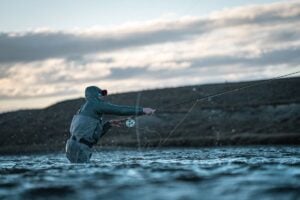
This is demanding, single-focused fishing. The southwest wind is constant, distance casting is not optional, and two-handed Spey experience makes a material difference to how effectively an angler covers the water. The season runs late December through mid-April, with peak weeks generally falling between mid-January and mid-March. For a full account of how the beat system works, what each month delivers, and what the fishery requires, see our guide to sea-run brown trout fishing in Argentina.
Río Gallegos, Santa Cruz – Sea-Run Brown Trout
The Río Gallegos rises in the southern Andes of Santa Cruz province and runs east across open plateau to the South Atlantic — shallower than the Río Grande, with more character along its banks: cut banks, rocky bluffs, willows, and defined pool formations. An estimated 70,000 to 90,000 sea-run brown trout return to the river each season, with fish averaging nine to ten pounds and legitimate prospects of 20-pound-plus fish throughout.
Because fish are distributed across the shallower water rather than concentrated in deep pools, lighter lines, smaller flies, and stealthier wading are the norm — and single-hand rods are as effective as two-handers. The Río Gallegos also holds a healthy population of large resident browns alongside its sea-run fish, making it the only river in southern Patagonia where both anadromous and resident fish of genuine size share the same water.
The season runs January through mid-April, with February and March the most productive months.
Which Patagonia Experience Suits You
Each of Patagonia’s regions rewards a different kind of angler — and each warrants a separate trip. The northern lake district for variety and depth of water types within a single week. Central Patagonia for wild fishing with far fewer rods. Southern Patagonia for the specialist pursuits that demand full commitment.
Once you know which pursuit suits you, the practical side of planning is covered in our guide to planning a Patagonia fly fishing trip, and how lodge weeks are actually structured in how Patagonia fly fishing lodge programs are structured.
When you’re ready to compare specific programs, the Patagonia Argentina fishing lodges guide is the natural next step.