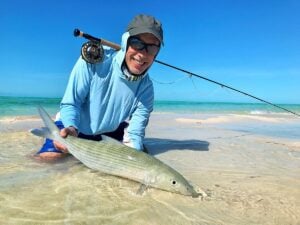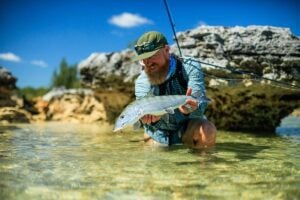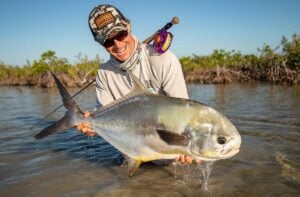
Of all the technical demands saltwater fly fishing places on an angler, few match what the Bahamian flats require. The cast, the retrieve, and reading fish behavior in real time — each part of the process has to work, and quickly. The window between spotting a fish and delivering a fly is measured in seconds. What happens in those seconds is what this guide is about.
Fly fishing for bonefish is technically demanding in ways that aren’t immediately obvious. The sequence from the guide’s call to a running fish is fast, and each stage has to execute correctly — the cast lands precisely and quietly, the fly sinks at the right rate, the retrieve reads as prey, and the angler is watching the fish closely enough to adjust in real time. A failure at any point ends the shot.
This guide covers the mechanics of bonefish fly fishing in depth — the cast, line management, reading fish before and during the shot, the retrieve, and how the shot sequence works from the guide’s first call to the strip-set. For broader context on where to fish, gear, regulations, and best timing, see our guide to how to catch bonefish in the Bahamas.
What Makes Fly Fishing for Bonefish Different
Most saltwater fly fishing allows some margin for error. Bonefish fly fishing in the Bahamas does not. The fish are fast, acutely aware of movement, shadow, and sound, and the water is clear enough that a misplaced cast or a retrieve that pulls the fly toward the fish rather than away from it ends the shot immediately.
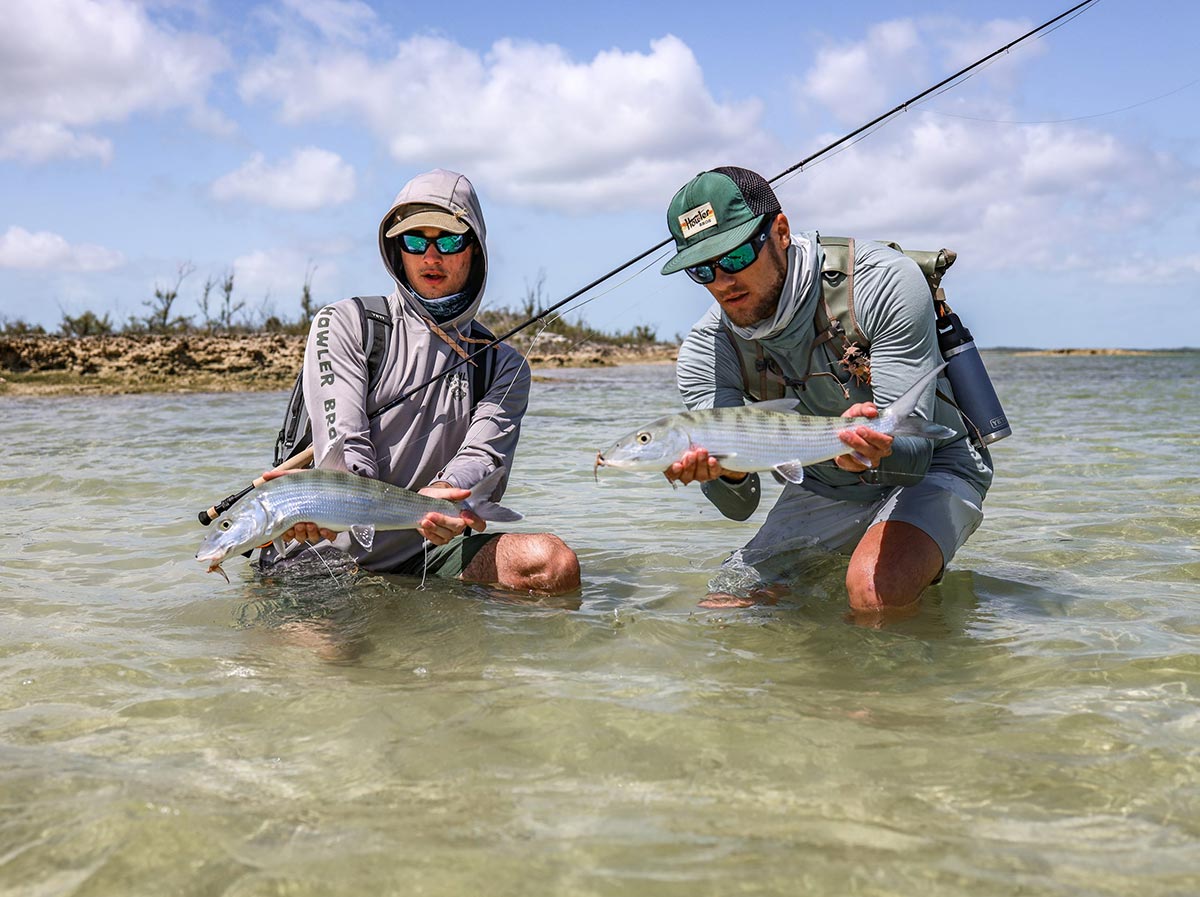
The sequence that has to work is: cast, land, sink, strip, set. Each element is distinct, each has specific failure points, and a break anywhere loses the fish. What makes bonefishing in the Bahamas the benchmark for this kind of fishing is that the conditions — often excellent water clarity and consistent trade winds — make every part of that sequence harder than it is anywhere else. Anglers who develop their technique here generally perform better on any flats system they fish subsequently.
This article looks at each element in turn, starting with the cast — because without an accurate, well-timed delivery, nothing that follows matters.
The Cast — Accuracy, Line Speed, and Wind
Fly fishing for bonefish places specific demands on the cast — accuracy under pressure, fast delivery, and the ability to perform in wind — that differ from other freshwater fly fishing experiences. Distance is rarely the limiting factor. Accuracy, delivery speed, and the ability to cast effectively in a crosswind are what determine whether a shot converts.
Accuracy Over Distance
Most shots on the Bahamian flats are between 30 and 50 feet — well within range for a prepared fly angler. What makes them difficult is the precision required and the time available. The fly needs to land 3–6 feet ahead of the fish depending on its speed and depth — close enough to intercept its feeding path, far enough not to land on top of it.
The fly also needs to enter the water quietly. A hard landing — from a poor turnover, an overweighted fly, or too much delivery power — will spook fish, particularly in shallow water or in calm conditions. A lightly weighted fly on a long leader gives the cleanest entry and is the right choice when fish are close and the water is thin.

False casting is the most common technical mistake visiting anglers make on the Bahamian flats. Every false cast costs time and risks spooking the fish. The standard for bonefishing is one backcast and one forward cast. That requires line speed — which is what the double haul provides.
The Double Haul in Wind
The double haul is not a technique reserved for experienced saltwater casters. It is the baseline for fly fishing for bonefish in the Bahamas, where trade winds are a near-constant variable from November through April. Without it, delivering a fly accurately at distance in a crosswind can be a challenge. With it, a competent caster can quickly make on-target deliveries in conditions that would otherwise cost shots.
What the double haul does is load the rod faster than a standard cast, generating more line speed. More line speed produces a tighter loop, better wind penetration, and the ability to shoot line accurately with minimal false casting.
The casting mechanics, in four stages:
- Begin the backcast and simultaneously pull down on the fly line with the stripping hand — the first haul. This accelerates line speed as the rod loads.
- As the loop unrolls behind you, let the stripping hand drift back up toward the rod butt — repositioning for the second haul without losing line control.
- Drive into the forward cast and pull down hard again with the stripping hand — the second haul. This is where most line speed is generated.
- Release line into the shoot as the rod unloads and the loop unfurls toward the target.

Haul timing is the critical variable. A haul that starts too early or too late doesn’t load the rod effectively. Practice until both hauls are automatic — on the flat, when the guide calls the fish, there is no time to think through your technique.
Wind management on the Bahamian flats comes down to three adjustments, each addressing a different part of the problem.
Loop shape is the first. A tight, narrow loop cuts through wind where an open loop stalls and drops short. Loop shape is controlled by the rod tip path — a short, crisp stroke with an abrupt stop produces a tight loop; a wide, sweeping stroke opens it. In windy conditions, the stroke should be compact and the stop decisive.
The punch is the second. Into a headwind, the forward cast needs to be driven rather than presented — a hard, accelerating stroke that forces the loop through the wind rather than trying to carry over it. The common mistake is easing off at the delivery, which opens the loop at exactly the wrong moment. Commit to the forward stroke fully and stop hard.
Rod angle is the third. Keeping the rod high on the forward cast raises the loop’s trajectory and exposes more of it to the wind. Dropping the rod tip lower on the stop — aiming the loop at the water rather than above it — keeps the trajectory flat and reduces wind resistance across the full length of the loop. In a strong crosswind or headwind, a lower delivery angle consistently outperforms a high one. Taken further, a sidearm or near-sidearm delivery puts the rod below the angler’s sightline entirely, gets the loop under the worst of the wind, and eliminates rod shadow on the flat — useful in both wind and calm, shallow conditions where a high rod overhead disturbs fish.
Line Management on the Flats
Poor line management loses shots that the cast itself would have converted. It is a separate skill from casting, and one that visiting anglers frequently underestimate.
Before the guide calls the fish, strip enough line to cover the expected shot distance and have it organized — coiled in a stripping basket if the lodge provides one, or in loose coils held in the line hand. Line coils need to be clear of boat hardware, feet, and anything else that can catch a loop on the shoot.
On the shoot, guide the running line through the fingers of the line hand rather than releasing it entirely. This keeps control through the delivery and prevents the line catching on the way out. Feeding line cleanly through the guides as the loop unfurls is what allows the fly to reach the target rather than pulling up short.
When the skiff is drifting toward the fly during the retrieve, strip faster than feels natural — the boat is closing the distance and slack accumulates quickly. When drifting away, the tension is already working in your favor and the retrieve can slow accordingly.
Reading Fish — What to Watch Before and During the Shot
The cast and the retrieve get most of the attention in bonefish fly fishing, but the two seconds before the cast — reading the fish’s direction, speed, and behaviour accurately — determine whether everything that follows has a chance of working. A well-executed cast to the wrong spot, or a retrieve started before the fly has reached the right depth, loses the shot regardless of technique.
Before the Cast
The guide’s call gives you direction, distance, and movement: “Ten o’clock, 40 feet, moving left.” All three need to be processed simultaneously. Direction tells you where to point. Distance tells you how much line to have ready. Movement tells you how far to lead — and the lead distance depends on both speed and water depth.
A fish moving at moderate pace in two feet of water needs a lead of around four feet. A faster fish, or one in deeper water where the fly needs more time to sink, needs more. A tailing fish — stationary or near-stationary, feeding head-down — needs the fly placed close and allowed to sink without movement until the fish begins to move toward it.
Understanding what you are looking at before the cast is as important as the lead distance:
Tailing fish are feeding actively with the tail breaking the surface. They are the most catchable presentation on the flat — focused on food and less alert to overhead movement than a cruising fish. The fly should land quietly and close, sink to the bottom, and be stripped slowly once the fish orients toward it.

Cruising fish are moving with purpose, often in pairs or small groups. They require a precise lead and a fly that is already sinking when the fish arrives at the target area. A fly that hasn’t reached the feeding zone when the fish arrives gives you little to work with.
Nervous water — a subtle surface push or ripple inconsistent with the wind — often indicates a moving school below. The target area is broader, the lead less critical, but the retrieve matters more because multiple fish are evaluating the fly simultaneously.
Single fish versus a school changes the approach. With a school, any fish that takes is a result — cast to the leading edge. With a single fish, that fish is the only opportunity, and the presentation needs to be precise.
During the Retrieve
Once the fly is in the water, watch the fish rather than looking for the fly. The fly is not clearly visible in most light conditions anyway, and the fish is the only reliable source of information about what is happening below the surface.
What committed looks like: the fish’s nose tips down, its body angle changes, and it accelerates toward the fly. Continue stripping at the same cadence — do not speed up, slow down, or pause. The fish has made its decision.
What spooked looks like: a sudden direction change, a tail kick, or an acceleration away from the presentation. There is no recovery from a spooked fish on the same shot.
What indecisive looks like: the fish slows, tracks the fly at distance, or makes a partial turn without committing. This is where retrieve adjustment is worth trying — a pause, a change in strip length, or a full stop can re-engage a fish that hasn’t decided. Speeding up rarely works and frequently ends the shot.
In good light and shallow water, you can anticipate a take before you feel it — the fish tips nose-down and stops. A bonefish inhales the fly rather than striking. Strip-set immediately at that point, without waiting to feel the take.
The Retrieve — Strip Technique in Depth
There is no universal correct retrieve for bonefish fly fishing. The right strip length, cadence, and use of pauses depends on what the fish is doing. The techniques below are tools, selected in real time based on what the fish shows you — not a sequence to work through in order.
Short, Sharp Strips and Figure of Eight
Short strips of 6–12 inches — pulled from the fingertips rather than a full arm draw — are the most versatile retrieve on the Bahamian flats. They keep the fly moving without pulling it far from the strike zone, mimicking a shrimp or crab making short evasive movements rather than fleeing outright.
Use short strips when a fish is following but hasn’t committed — tracking the fly at close range and needing to be kept interested without the fly being pulled out of reach. This is also the retrieve for tight water: narrow creek mouths, shallow flats where a long strip would drag the fly off the edge of fishable depth. The risk is overuse — too many short strips on a cautious fish can read as frantic rather than natural, and a more deliberate pace often serves better.
A figure of eight retrieve is a useful alternative to discrete strips. Rather than pulling line in individual movements, the line is looped continuously in a figure of eight pattern in the palm of the line hand, producing a smooth, uninterrupted fly movement. It maintains constant tension and eliminates the micro-pauses between strips that can sometimes cause a following fish to lose interest.
The Pause and Drop
Stopping the retrieve and allowing the fly to sink is one of the more effective triggers in bonefishing, and one of the least used by visiting anglers who associate motion with interest.
When a fish has been tracking for several strips without committing — sizing up the fly at close range — stop stripping and let the fly drop to the bottom. A weighted fly sinking naturally mimics a shrimp or crab diving for cover, which is the behaviour most likely to produce a commitment from a fish that is close but undecided. The take often comes as the fly drops, or on the first strip after it hits bottom.
Be ready the moment you pause. The take that follows a pause is frequently fast — watch the fish, not the line, and strip-set at the first sign of commitment.
Dead Stop
The dead stop is the hardest retrieve to execute because it requires doing nothing, which feels wrong when a fish is within range.
Use it when the fly has landed close enough that the first strip would pull it toward the fish rather than away from it. Prey do not move toward predators. A fly sitting motionless on the bottom reads differently from one moving in the fish’s direction, and in the right situation it is the only retrieve that gives the shot a chance.
Let the fly sit. Once the fish has moved past it or oriented away, a single short strip can re-engage without triggering a spook. Patience is the technique — and for most anglers it is the hardest part of how to bonefish effectively.
The Strip-Set
The strip-set is the single most important habit to build before arriving on the flats, and the one that experience in other forms of fishing most reliably undermines.
When a bonefish takes, the instinct is to raise the rod. In almost every other form of fly fishing, lifting the rod sets the hook. On the flats it pulls the fly directly out of the fish’s mouth.
The correct response is to strip firm and downward with the line hand — a sharp, decisive pull — while keeping the rod low and pointed at the fish. The hook sets into the corner of the mouth. Then the rod comes up as the fish runs.
Practice this specifically before the trip. Cast to a target, strip to it, and strip-set as the pickup rather than lifting the rod. It takes deliberate repetition to override the instinct, and on the flat there is no time to think about it. It needs to already be automatic.
Boat Positioning and the Shot Sequence
Fly fishing for bonefish from a skiff is a two-person operation. The guide’s job and the angler’s job are distinct, and understanding both makes the partnership more productive.
How Guides Position the Skiff
The guide poles the skiff to create a clean casting lane — an angle that puts the fish at the right distance, with the wind working for rather than against the cast, and no obstacles between the bow and the target. This requires constant adjustment as wind, tide, and fish direction change.
An experienced guide poles into or across the wind — this keeps boat noise and movement away from the fish and gives the angler a cleaner casting lane.

When the skiff is drifting toward the fly during the retrieve, strip faster than instinct suggests — the boat is closing the distance and slack accumulates quickly. Like most forms of fly fishing, a slack line during a take often leads to a missed opportunity. When drifting away, the retrieve can slow. Know which is happening on every shot and adjust without waiting for the guide to tell you.
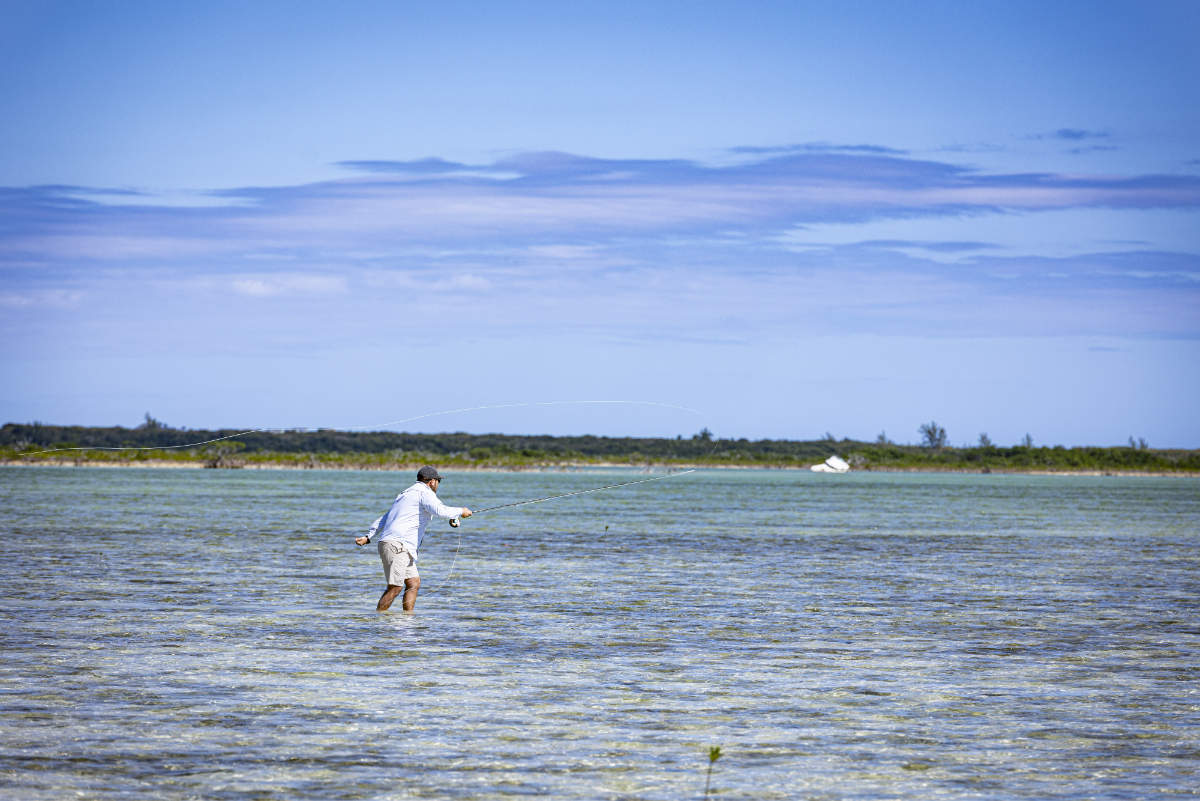
Wading is worth understanding as an alternative even within a skiff-based program. On firm-bottomed flats — Cherokee Sound, the southern Abaco ocean flats, the white-sand systems of South Andros — stepping off the skiff eliminates boat shadow and sound entirely. Guides make this call based on bottom type and conditions. When they suggest it, take it.
The Shot Sequence
The full shot sequence from the guide’s first call to a running fish unfolds quickly, and knowing each stage in order removes hesitation:
- Guide calls the fish — direction, distance, speed. Process all three immediately.
- Strip line and load — have the right amount of line ready before the call if possible. The rod should be loaded and the angler in position on the bow before the cast begins.
- One backcast, deliver — no false casts, no hesitation. The fly lands 3–6 feet ahead of the fish, quietly, with a clean turnover.
- Fly lands, sink — let the fly reach the right depth before the first strip. In shallow water this is immediate; in deeper conditions, allow a beat or two (depending on line type and weight).
- First strip, watch the fish — begin the retrieve and shift full attention to the fish. The fly is no longer the reference point.
- Adjust retrieve to fish behavior — read what the fish shows you and respond: maintain pace, pause, stop, or change strip length.
- Take — strip-set — line hand strips firm and downward, rod stays low.
- Fish runs — rod comes up, side pressure applied, fish runs against the drag.
The sequence is straightforward in isolation. Under pressure — with the guide calling direction changes and a fish moving faster than expected — it compresses into a series of reflexes. That is why practice before the trip, for those who want to arrive ready, pays dividends.
Preparing for the Flats
For anglers who want to arrive with the mechanics already in place, practicing beforehand will make for a more productive bonefishing trip. A good guide will work with anglers at any level, and nothing accelerates the learning curve faster than actual shots at real fish — but the more that’s already automatic, the more attention is free for reading the water and the fish.
The most useful preparation an angler can do before a bonefishing trip is practice the mechanics of casting until they require no conscious thought. On the flats, attention spent on casting or retrieve technique is attention taken away from reading the fish — which is the part of the Bahamas bonefish fly fishing experience that cannot be automated.
Set up targets at 30, 40, and 50 feet in open ground. Practice delivering to each with one backcast and a clean shoot, using the double haul as the default on every cast rather than as an occasional addition. If casting into wind is possible in practice, use it — a crosswind delivery to a target at 40 feet is a closer approximation of Bahamian flats conditions than any calm-water session.
Have a partner call directions: “Ten o’clock, 35 feet, moving fast.” React, load, cast. The call-and-react drill builds the reflex of processing the guide’s call and acting on it immediately — a separate skill from casting itself, and one that visiting anglers consistently underestimate until they lose the first few shots to hesitation.
Practice the strip-set specifically and deliberately. Cast to a target, strip to it, and strip-set as the pickup — not a rod lift. One session is not enough. The instinct to lift the rod is deeply ingrained in most fly anglers, and reversing it requires repetition over multiple sessions before the trip.
Vary retrieve cadence: short strips, pauses, dead stops, changes in rhythm. What you are building is not realism — a backyard doesn’t replicate the flats — but motor memory for different strip lengths and transitions, so that adjusting mid-retrieve on the water is instinctive rather than deliberate.
The closer these feel to instinct when you arrive on the flats, the better your fishing will be.