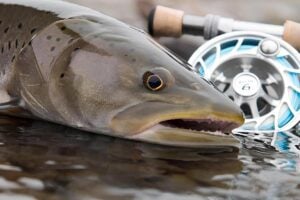
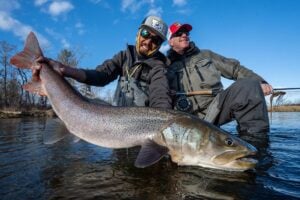
Taimen are the largest salmonids on earth, and Mongolia’s protected northern and northeastern rivers are one of the few places left where you can cast a fly to them. Taimen fly fishing often means covering miles of water in a single day from drift boats, or wading boulder-strewn runs and pools that demand sure footing. If the timing and location are right, a good day brings explosive takes and the chance of landing a fish of 40 inches or more.
Taimen are apex predators that spend their whole lives in the river, feeding on small fish, and mice, ducklings and gophers that end up in the water. An adult can travel more than 50 miles of river in a year, so the fishing is about covering water and being ready when a fish takes. That shapes the gear: powerful rods, strong leaders and hooks, and flies that move water and draw a strike.
Below we cover rod setups, flies, where taimen hold, how to retrieve a fly and set the hook, and when the fish feed best. Our taimen species page covers the fish itself, and the Northern Mongolia region page covers some of the main taimen rivers in a little more detail.
What Rod and Line Do You Need for Taimen Fly Fishing?
Casting is what wears you down on a taimen trip, and a big fly in a strong wind is hard work with the wrong setup. The right rod also depends on the water you fish, which can range from wide, slow-moving pools to fast, deep channels.
A 9 foot, 8 or 9 weight single-handed rod is the go-to for most taimen fishing, and it is the usual choice when casting from a boat. A 10 weight earns its place for the heaviest flies and sinking lines. Lighter trout tackle in the 4 to 6 weight range covers lenok and grayling, which share the same rivers.
Many Mongolian rivers are big water, so from the bank or when wading, a two-handed or switch rod is often the better tool. Combined with a Skagit line, a two-hander covers more water with less effort and takes much of the strain out of a week of casting large flies into the wind and across broad pools. Rods of 11 to 14 feet in 8 to 11 weight are the usual range, and an 8 weight switch rod of about 11 feet suits large mice patterns. Some anglers go as heavy as 12 weight for the biggest flies in more challenging conditions.
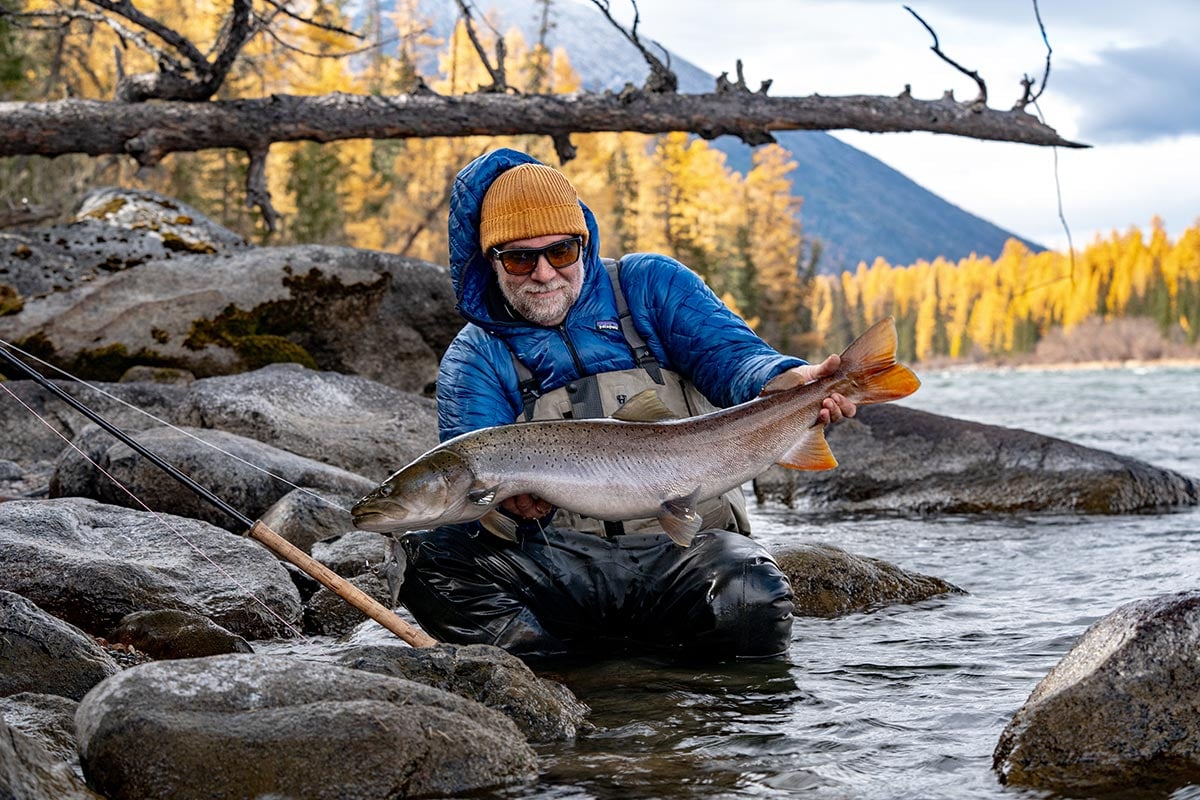
A floating line does most of the work, as taimen look up and move upward to feed and will readily take surface flies. Choose an aggressive front taper, slightly overlined, so it loads the rod and turns over big, wind-resistant flies.
Add a sink tip line matched to your rod weight to your pack list, so you can fish streamers in deeper pools. Interchangeable tips let you change depth quickly as the water changes.
Your choice of reel is as important as the line and rod. Bring a good-quality reel with a sealed drag system that is smooth, strong and easy to adjust precisely. The reel should hold 150 to 200 yards (140 to 180 meters) of backing, as a big taimen once hooked can take a lot of it.
Leaders, Tippet and Hooks for Taimen
A taimen fights with real power and has jaws that are tough to penetrate, so the connection and the hook decide whether a take becomes a landed fish. Test the join between leader and fly line with a firm tug before you fish. A weak knot or a nicked leader is a common failure point.
Straight fluorocarbon leaders of 20, 30 and 40 pound, roughly 0.40 to 0.60 mm, are the standard, attached to the fly line with a loop-to-loop connection. A 7 to 9 foot tapered leader in 20 to 30 pound also works well. Leader and tippet choice depends on the water you fish, so carry spare spools of each strength and check your guide’s pre-travel information.
Hooks need to be strong, sharp and wide in the gape. A taimen has a very hard mouth, and a weak hook will not penetrate or hold. Most taimen flies are tied on hooks from 1/0 to 4/0, and some go to 5/0. Go much smaller and you risk poor holding power. Go much bigger and you add to the risk of injuring the fish.
In most taimen sanctuaries fishing is fly only, with a single barbless hook. Outfitters and lodges send a tackle list in advance, so you will know what to bring, and flies are sometimes supplied or sold by the guiding team on the river.
The Best Flies for Taimen
Most taimen fishing happens on the surface, where you see the fish smash the fly in plain sight. A fish hits a skated mouse or gurgler with explosive force, often leaving the water as it does. Deer-hair mice, gurglers and poppers are very effective, and compact poppers on 1/0 or 2/0 hooks are can be very productive even for large fish. Surface disturbance matters, and in murky water, where a taimen tracks vibrations, a fly that pushes water draws the strike
Taimen flies are measured in inches, but you do not always need a giant one. A taimen will eat a 3 or 4 inch streamer as readily as a 10 inch fly, and a smaller fly is easier on your arm over a full day. Carry a mix: gurglers of 3 to 8 inches, streamers from 3 or 4 inches up to 10 or 12, and a few oversized flies for the days they suit.
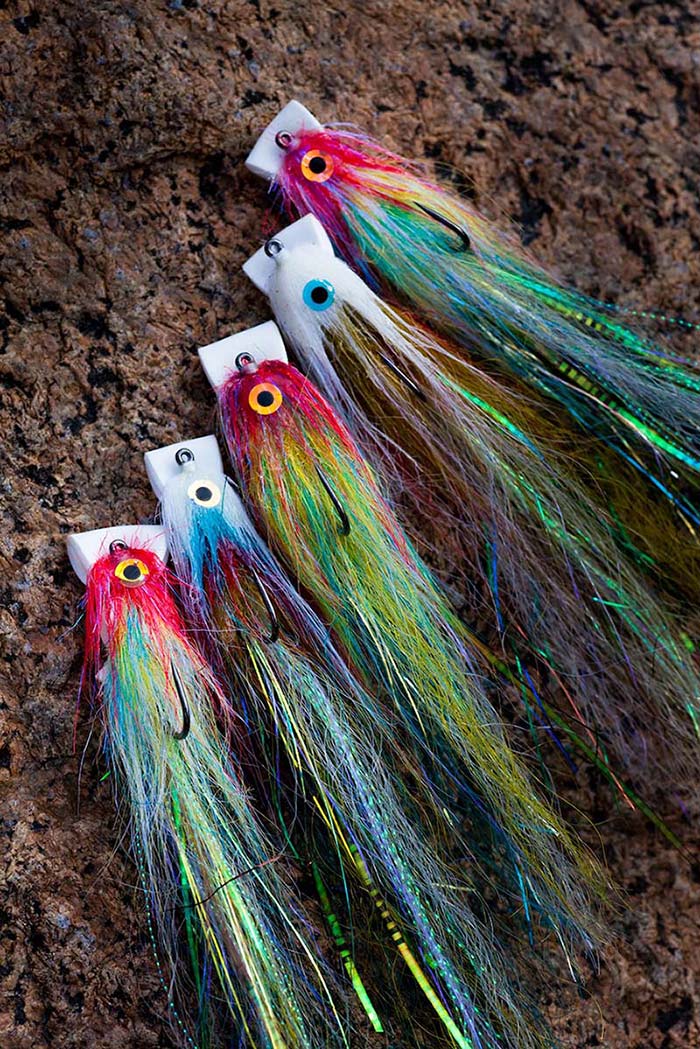
Below the surface, streamers imitate the fish that make up the taimen’s main diet. Light colors such as white, tan and gray imitate those fish, and darker ones such as olive and black give the silhouette of a rodent or other prey struggling in the current. Streamers need little weight, and a sink tip on your line does the work of getting them down further if required. Flies designed for pike often work well too.
Seasonal timings also change the choice of fly. Mice and other surface flies are most productive early in the season and in low, clear water. Sink-tip streamers earn more of the fishing as the season goes on and the water cools.
Where Do Taimen Hold in a River?
Taimen are spread out and on the move, so the fishing is about covering water and knowing where a predator would wait. They are ambush hunters that conserve energy, and they hold where the current gives them cover and food. Cast to boulders, downed timber, overhanging bushes and undercut banks, and fish the slack water in front of and behind each obstacle. Seams, back eddies, tailouts, channel confluences and drop-offs all hold fish, and large taimen favor big pools with shelter nearby and current entering at the head.
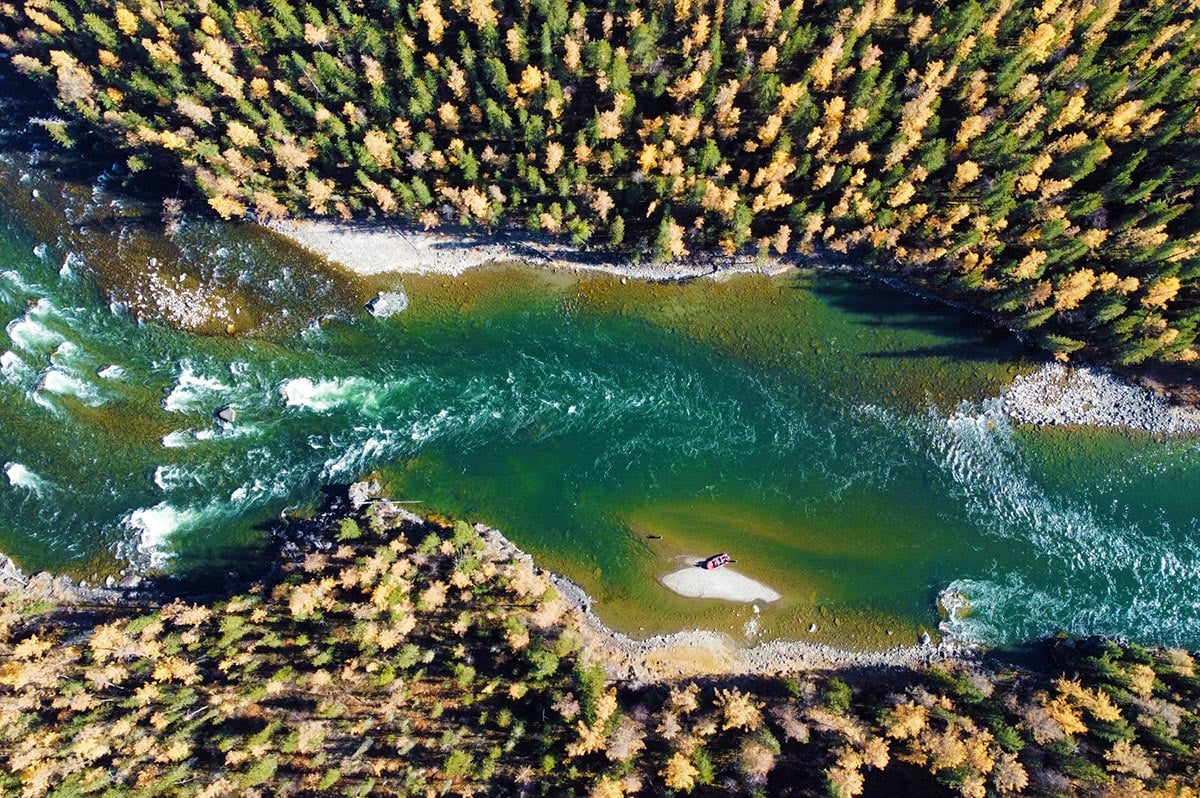
Not every taimen is hiding. Fish also cruise shallow water along the willows hunting trout, and at times they work in groups of two or three. Low, clear water lets you sight-cast to them on shallow flats, while high or off-color water holds fish close to the banks.
How to Retrieve a Fly, Set the Hook and Land a Taimen
A taimen will often strike as the fly swings across the current or while it is being actively worked.
To swing the fly, cast down and across the river, adjusting the angle to the flow so the fly swims steadily across the surface. Keep the rod tip low and the line taut. Takes often come over deep or bouldery water, with fish following the fly before they strike.
To work the fly, riffle-hitch a mouse or muddler so it twitches through the surface film, or draw a gurgler across the current so its wake does the work. Keep the pulses short and steady, and move the cast 8 to 10 feet between throws so each one covers new water.
With streamers, cast across the current and strip methodically, with pauses. A constant strip draws followers, but a taimen often waits for the pause before it commits. Let the fly sit for a moment, then step downstream and repeat, and strip with more vigor once a fish shows.
The take is explosive, and what you do in the next second decides whether the fish is hooked. On a swung fly, tighten with the line hand, rod still low, to bury the hook. On a stripped fly, keep stripping until you feel the weight of the fish, then use a firm strip set with the rod pointed at it. Lifting the rod too early often pulls the fly away before the hook has taken hold, and this is where many anglers lose fish. Repeat the strip set if needed.
If a taimen misses, stop the retrieve and let the fly sit, or put it straight back on the water. A fish that misses often comes back for a second, third or fourth strike.
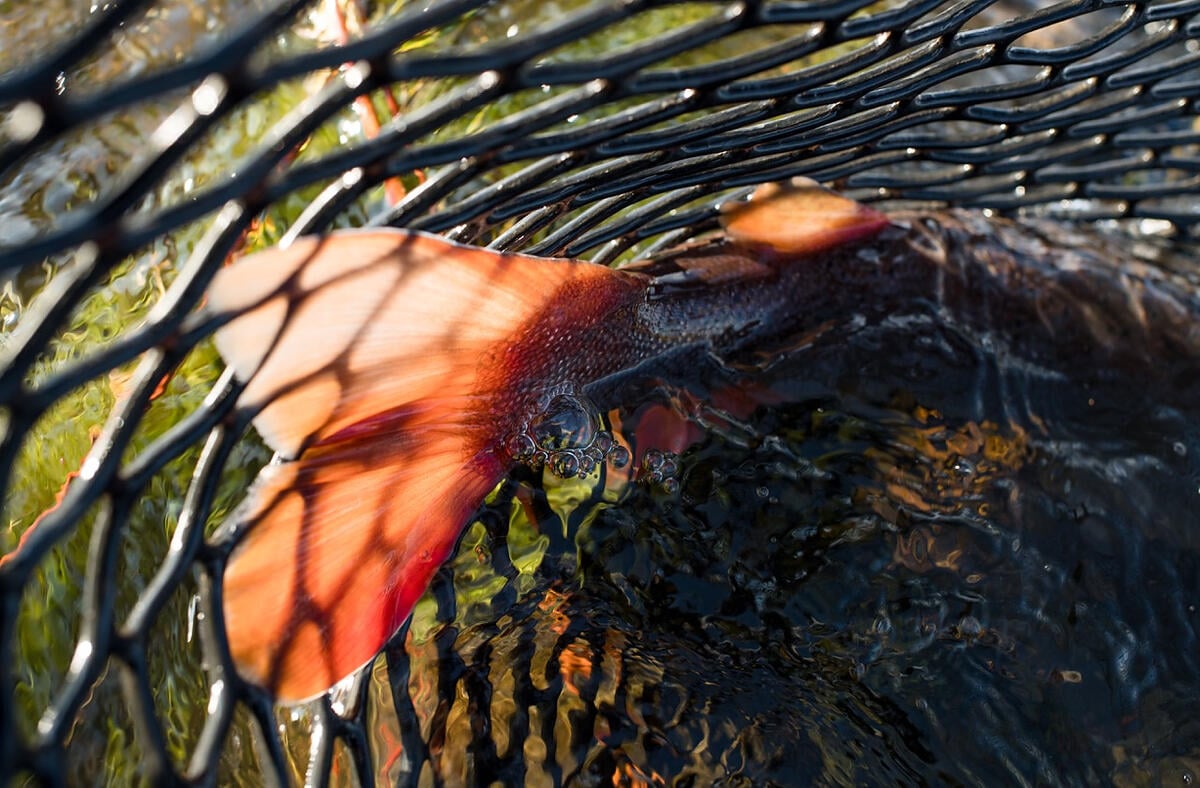
Once hooked, a taimen leaps, shakes its head and often runs hard into the backing. Keep steady pressure on the fish and be ready to follow it down the bank. Big fish run repeatedly and sulk near the bottom between runs, so expect a long fight. When the fish tires, bring it toward slack, shallow water. Your guide will step in to net the fish when it is ready, and a fish too big for the net is guided into the shallows.
How to Release a Taimen
Once a taimen is netted, or guided into the shallows if it is too large to net, keep it in the water as much as possible while you remove the hook. Long-shank forceps should be clipped to your jacket so they are quick and easy to reach. Wet your hands before you touch the fish, support it under the belly and tail, and keep your fingers away from the gills. When releasing the fish, hold it facing the current until it swims off on its own. Keep photos quick, since the longer a fish is out of the water, the longer it needs to recover.
Catch and release is the rule for international anglers on permitted rivers, and the reason is the state of the fish. The IUCN lists the Siberian taimen as vulnerable, and it is listed as endangered on Mongolia’s national red list. Populations are in decline from poaching and habitat loss. A taimen needs at least 10 years to reach one meter, and the species can live for more than 30 years.
A 2009 study of the Eg and Ur fishery, published in the Canadian Journal of Fisheries and Aquatic Sciences, modeled what would happen if every fish were kept: at the study fishery’s catch of about 240 fish a year, retention gave a 57 percent chance of local extinction. The existing catch and release fishery, by contrast, was estimated to have reduced taimen numbers and biomass by less than 10 percent.
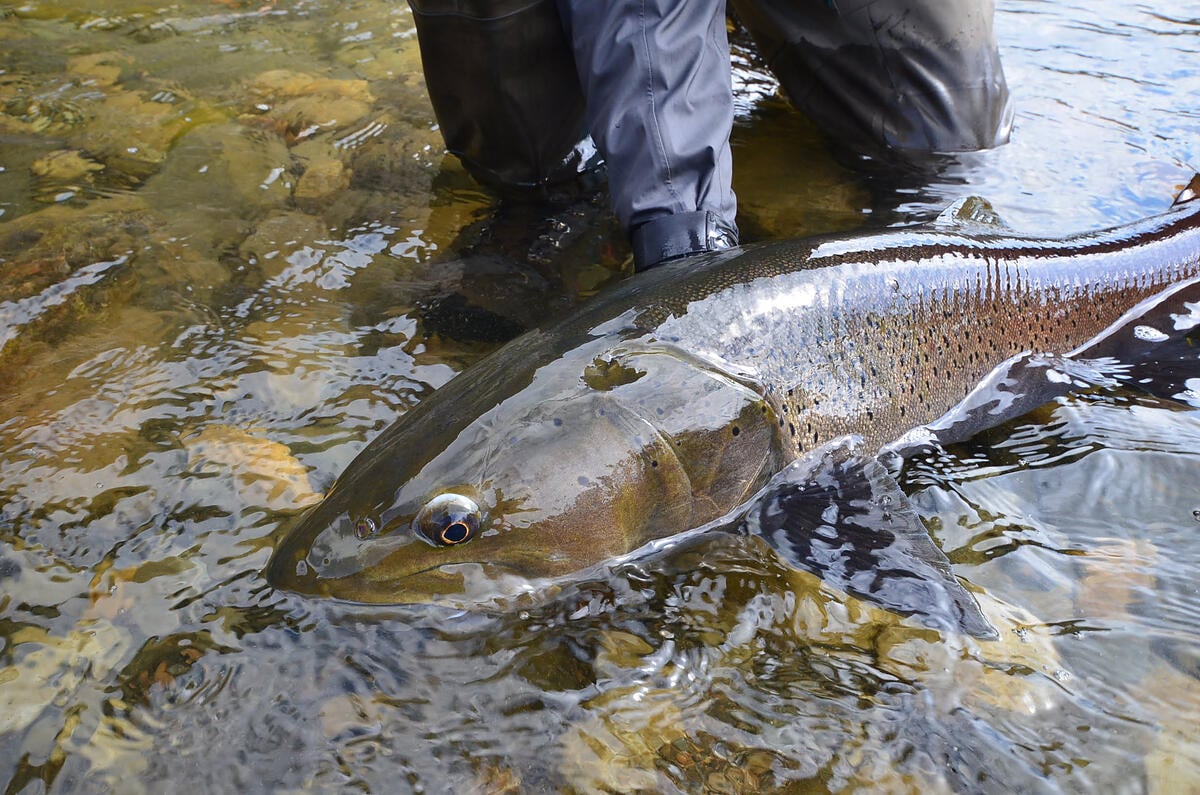
Release itself is not risk-free. The same study estimated that between 4 and 9.6 percent of released fish died, and noted that more harmful gear, such as multi-barbed hooks, could push that figure higher.
When Is the Best Time for Taimen Fly Fishing in Mongolia?
Taimen have a short season to feed. Winter temperatures in Mongolia fall to minus 40 degrees or lower and the rivers freeze for months, so the best fishing falls in the months after the thaw and before the freeze. Mongolian authorities close fishing each spring, and the season opens on June 15 and runs to the start of November. The rivers fish differently across it.
In mid-June the spring runoff has usually passed, and the water runs low and clear. The fishing is visual, with large mice patterns working on the surface. On eastern rivers the summer rains ease by late August, and flows drop and clear. From late August into early October, cooler nights and cooler water bring stable conditions and aggressive feeding ahead of winter, and these weeks offer the best conditions for large taimen. By October the weather turns cold and winter conditions begin to set in, but taimen are still feeding hard before the freeze.
Weather moves fish. Cloud cover, wind and a little rain can switch them on, and early morning and late afternoon are the best hours. A river rising or falling between fishable and unfishable can unsettle them for about a week, and heavy rain can stain the water for days. Stained or murky water makes the fishing harder, though big dark flies can still work.
Even in the best weeks the fishing is uneven. A day of double-digit fish can be followed by one with very few takes, and persistence is what pays.
What to Know Before a Taimen Fly Fishing Trip
A taimen day is a long day of casting big flies, with long stretches between takes. You do not need exceptional casting skills, but you do need to cast well for hours and stay patient. Practice with a rod of the weight you plan to fish and a fly of similar bulk. If you plan to use a two-hander, learn how to cast with a two-handed rod before you travel. Practice the strip set too, because the urge to lift the rod is hard to resist when a big fish takes.
Outfitters and lodges send a packing list in advance, so use it. Before you book, it is worth confirming:
- How much of the fishing is done by wading and how much is boat based
- What fishing gear is provided and what needs to be brought
- Which rods and lines are suitable
- What type of wading boots are permitted/recommended
- What fitness level is requiredTaxonomies
Weather, permits and travel to the river are covered on the Mongolia region page, and the Northern Mongolia region page briefly covers the main taimen rivers.